Exchange of Values

Exchange of Values
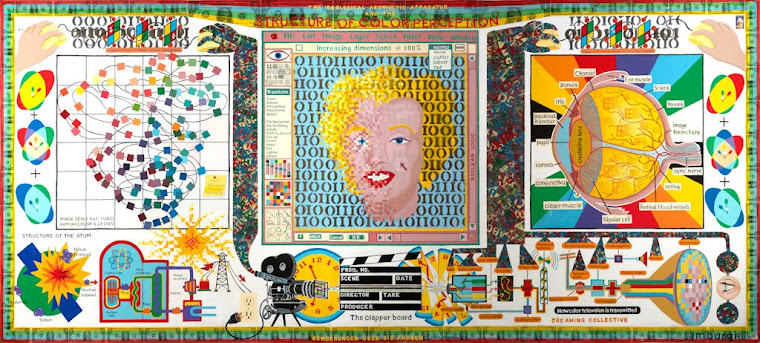
acrylic on board 48'X96'

"Structure of Color Perception"

"Structure of Color Perception"
48'X96' acrylic on board

Monday, September 23, 2013


***  Klediments:  From my spiritual director, Rabbi Mordechi Rosenbaum: ‘While Pharisees were fighting over theology, prostitutes were falling at the Savior's feet and slipping into the kingdom of God on their tears.’

***"  "Mercying"

Perhaps my favorite part of Pope Francis’s most famous recent interview was the neologism he created in this sentence: “Jesus saw a publican, and since he looked at him with feelings of love and chose him, he said to him, ‘Follow me.... I think the Latin gerund miserando is impossible to translate in both Italian and Spanish. I like to translate it with another gerund that does not exist: misericordiando [“mercy-ing”]."

Mercying.  Perhaps used in a sentence this way?:  Mercying the unclean woman who was inhabited by seven devils, Jesus took her in his arms and they drank wine and they cried and laughed and danced in the desert under the night sky.  Sometimes in their dance Jesus would fling the woman towards heaven and she would spin in the sky and sparks would shoot from her body like electric stars. Then he would draw her down, calling to her by her secret names and she would slowly whirl back down to the earth and her beloved.  And so even the devils were mercied into grace and the woman was set free.

*** “God Sees.”

Rabbi Ben: You don't think God sees?

Judah: God is a luxury I can't afford.

(From Woody Allen’s, “Crimes and Misdemeanors”).

I posed this question on Facebook late last saturday night:

“Much is written about ‘The Dark Nights of the Soul.’ Perhaps more needs to be written about the dark nights of the flesh? I pray for just enough grace that I may at least be counted among the sparrows.”

I received some thoughtful and challenging responses.  I know that I have several friends that also struggle with painful physical/spiritual/psychological infirmities that keeps them awake some nights and I will keep you all in my prayers.  But when my heart is inflamed and I can’t lie down and I must sit up in a chair all night, and there is too much pain for reading or even TV, I sit in the darkness for hours listening to my heart beating so erratically.  Sometimes, when there are long gaps between heart beats I see slight zips of light flashes and subtle changes and movement in the darkness.  Maybe it’s just a momentary lack of oxygen but sometimes I like to think that those flashes are tiny angels, maybe the spirits of birds or dragonflies or babies who only lived for a few seconds in their mother's womb.

In the dark nights what does it mean that “God sees?”  

Matthew 10: 29.  Are not two sparrows sold for a penny? Yet not one of them will fall to the ground apart from the will of your Father.

And yet we fall. The parable of the sparrows, as with all of Jesus’ parables, obscures as much as it reveals. Similar to my oblique anguished facebook post at midnight when most of my fb friends were peacefully asleep. It was sent to all, but only understood by a few. Like the difference between 2nd Samuel chaps. 13 and 14 and the novel “Absalom Absolom” by W. Faulkner. Some will already know what I mean (but even more blessed are those who do not). Our new Pope Francis is quite a master of revealing/obscuring as his recent interview demonstrates. He says: “Only in narrative form do you discern, not in a philosophical or theological explanation....The mystical dimension of discernment never defines its edges and does not complete the thought. The Jesuit must be a person whose thought is incomplete, in the sense of open-ended thinking. There have been periods in the Society in which Jesuits have lived in an environment of closed and rigid thought, more instructive-ascetic than mystical: this distortion of Jesuit life gave birth to the Epitome Instituti.”

All that is to say, that in the dark nights, as the pain-killers wear off (but of course they don’t *kill* pain, drugs only use our own god-like capacity for imagining paradise to deceive us) it’s best to not over-think the parables, and leave the edges undefined (has Pope Francis been reading Of Grammatology?).  PF has also apparently adopted the motto of Pope John XXIII, ‘See everything; turn a blind eye to much; correct a little.’ Did he learn that from the Holy Spirit too,  or from his mother, or is that an institutionalized way of spinning the gospel of the falling sparrows? Let me prescribe to anyone who struggles to understand this parable and who also suffers from painful sleepless nights, to study Woody Allen’s (perhaps) greatest film, and one of my favorites, “Crimes and Misdemeanors” (maybe the only film with a character patterned after Heidegger?). 

Then again, maybe there are more helpful readings one could reflect on in your dark night.  like this from Matthew Fox in “Original Blessing” : “Facing the darkness, admitting the pain, allowing the pain to be pain, is never easy. This is why courage – big-heartedness – is the most essential virtue on the spiritual journey. But if we fail to let pain be pain – and our entire patriarchal culture refuses to let this happen – then pain will haunt us in nightmarish ways. We will become pain’s victims instead of the healers we might become.” Of course, that sort of thing always reads better in the sunshine and when it’s about someone else’s pain.  Still, once one surrenders to the proposition that “God sees,” that is only the beginning of a long journey. Perhaps we’all have gotten so caught up up in the narrative of king David and and his son Absolom that we forgot about Tamar? Does God see Tamar? Do we?

And so we fall
But the god of the sparrows
Falls with us

Falling first before
Gravity
Or it’s theory

Falls with us
Not instead
Not hardest

Some might have
Thought “jumped!”
Others “pushed”

We crash and shard
God, sparrow, and I
A mash of smithereens

But even
Smithereens
May fly


Much obliged. 

Saturday, August 31, 2013


Klediments:  Buzz Bombs

The president is making his case for “striking” Syria.

The Pink salmon runs are surging through Puget Sound along with some Silvers and Kings (although we can’t keep the Kings anymore and must throw them back).  Fishing madness is invading the Island!

So it’s war then, again! 

Most fishers are using “Pink Buzz Bombs.”  Last night I saw one guy using a silver-spoon spinner but he didn’t catch anything.  Then again neither did I.

“Surgical strikes,” he says.  I had one of those once, it damn near killed me.

“Our idea of God tells us more about ourselves than about Him.”  (Thomas Merton).  I think that may be true about our ideas about our ‘enemies’ as well.

The flesh of pink salmon are oily and soft and the fish don’t keep well.  They are best smoked or canned immediately.  Once the pinks hit the fresh water they start rotting quickly and will die soon.

"We cannot avoid missing the point of almost everything we do. But what of it? Life is not a matter of getting something out of everything. Life itself is imperfect. All created beings begin to die as soon as they begin to live, and no one expects any one of them to become absolutely perfect, still less to stay that way. Each individual thing is only a sketch of the specific perfection planned for its kind. Why should we ask it to be anything more?"  (Thomas Merton).

At the hardware store where I got my salmon fishing license (and a lot of other business all over the island) there are collection jars put out to raise money for a cute 5 year old girl with cancer.  Her family doesn’t have insurance and her treatment may cost as much 250.000 $  But so many people only carry cash cards these days that they don’t have change in their pockets.  Perhaps that is why the collection jar is almost empty?

I prefer a dry rub overnight with paprika, brown sugar, salt, pepper, and thyme.  Soaking pinks in a brine makes the flesh too moist for my palate.  Plus, the more fluid the more prone to spoilage and bacteria.   

“People...including children were murdered,” the president says, and that, “this menace must be confronted.”

There is a picture of 5 year old Alice on the collection jar.  She is bald and getting thinner and there are darkening shadows under her eyes.  She is smiling for the picture though.  It could break ones heart.

The Wash. state dept. of fisheries rules insist that fishers cut the barbs off of their hooks.  This limits the killing and allows some salmon to slip off the hooks and escape up river and spawn.  In theory I know that this makes sense.  But when I’m reeling in an 8 pound silver and it wiggles off my hook 5 feet from shore I swear silently and feel that I have been cheated.

The president asks:  “...what message do we send if a dictator can gas hundreds of children without consequence?”

Against common wisdom, fish don’t rot from the head first.  At least not pink salmon, they rot from the middle and then it spreads to the tail and then to the head.

High tide is at 5:30 tonight.  Those of us without boats must try and cast our lures as far as we can out into the surf to reach the schooling fish.  It’s frustrating to watch big salmon jumping just yards away from my farthest cast!  Sometimes I cast for hours without even a nibble, and then someone else shows up and starts fishing right next to me and catches their limit almost immediately!  It’s hard for me not to think of those fish as mine, that they have been stolen from me.  Shouldn’t there be some proportionality between effort and reward?  I can’t help but be a little pissed off.  It doesn’t help that he looks so deserving and smug. 

I see that Alice’s picture and story are posted on facebook now.  Her posting has gotten more than 650 likes and 30 shares!  Everyone is praying for her and giving her (((hugs))).  It’s the exact same picture as the one on the jars but somehow she looks more hopeful now, the smile less coaxed.  I “like” and (((hug))) her too.   

“Instead of hating the people you think are war-makers, hate the appetites and disorder in your own soul, which are the causes of war. If you love peace, then hate injustice, hate tyranny, hate greed - but hate these things in yourself, not in another.” (Thomas Merton).

He says: “what message do we send if a dictator can gas hundreds of children without consequence?”  I wish there was someway to “dislike” things on facebook.  I would certainly “dislike” dictators that kill children, and cancer too.

Other key phrases cast out:

“Make an example to other countries...
Ancient sectarian differences...
We must not turn a blind eye to what happens in Damascus...
Some things are more important than the politics of the moment...
Limited in scope...
Deter behavior...
National security interests...
This menace must be confronted...
Right makes might....”

(I reckon that that last line is supposed to be a clever play on that old saying that “might makes right.”  I wonder who came up with that idea and how many it will hook?).

"You are fed up with words, and I don't blame you. I am nauseated by them sometimes. I am also, to tell the truth, nauseated by ideals and with causes. This sounds like heresy, but I think you will understand what I mean.  It is so easy to get engrossed with ideas and slogans and myths that in the end one is left holding the bag, empty, with no trace of meaning left in it. And then the temptation is to yell louder than ever in order to make the meaning be there again by magic. Going through this kind of reaction helps you to guard against this. Your system is complaining of too much verbalizing, and it is right....  The big results are not in your hands or mine, but they suddenly happen, and we can share in them; but there is no point in building our lives on this personal satisfaction, which may be denied us and which after all is not that important."  (Thoman Merton).

I am going to try glueing  shiny yellow dots on the sides of my buzz bombs.  I am hoping that those reflective circles will look like fish-eyes and will fool some salmon into thinking that these painted lead buzz bombs are tasty little fish!

Obliged.   


(And special thanks to Beth Cioffoletti over at http://fatherlouie.blogspot.com/ for reminding me so often of Thomas Merton's words and wisdom.  And to Ben Myers over at the blog http://www.faith-theology.com/  for directing my attention again to the relationships among words and life).

Thursday, August 29, 2013

It's not you, it's me.


Ok.  Let’s just say that things between God and earth didn’t work out.  And let’s imagine that God and earth parted ways amicably (I know, I still have supplies left over from the Y2K cataclysmic scare!).  So then if God went shopping for a new planet and wanted to use the bible as a resume on God’s on-line profile.  And let’s say that for old times sake God asked Earth for our opinion on composing a dating profile. What parts of the bible would you suggest be emphasized?  What parts would you recommend God leave out completely?  And what parts would you just tweak a bit (you know, not actually lie, but just put the best possible face on things. I mean, can God wait until the third date before bringing up Noah and the flood?  Is it ok for God to call the destruction of all life on the planet a “reboot” rather than an a apocalyptic horror?).

Of course, this is a two way street cupcake so the same goes for Us.  If we were shopping around for a new God what parts of the bible’s story of Us should we mention, and what parts should we...say...conveniently forget until after consummation (of course there’s a few incidence like crucifying God’s son that might be a deal breaker for a lot of God’s so maybe it’s best that that bit of personal history remains in the vault).  Now any God reading our profile for sure knows that we’re somewhere between 6,000 and 6,000,000,000 years old so they would have to expect that Earth has some past baggage, a few scars, some stretch marks.  But under flattering lights and after a few beers I think the right sort of God could ‘drink Us pretty’ again don’t you?  

On a scale of one to five what overall dateabiity rating would you give to both God as God, and Us Earth dwellers as worshipers/believers/subjects/children/whatever?

Perhaps y’all can help me compose a singles ad for Earth?

Hi, my name is Earth.  I’v been out of a serious relationship for a while and I’m ready to jump back into the dating pool again! LoL.  I like long spins in the universe, fresh ozone, and no strings attached.

For now I’m not interested in anything too serious or any God that’s too clingy and needy.  I would really prefer an “open relationship” where we both could date others (before we went exclusive my last God became increasingly possessive until if I even looked at another God there was hell to pay!).

I’m looking for a God that’s not into rule-making, moralizing, and one that doesn’t need constant reassurance.  I’m not very introspective or interested in dredging up painful histories but enjoy living in the moment and having fun fun fun!  So if your the silent, brooding type of God then maybe you should keep looking for a different planet.  But, if you are like me and you are ready to live free and bust loose then let’s party together like spring break and let some one else worry about cleaning up the mess!

Favorite movies:  All those “Over Vermont” and “Over Chesapeake Bay” type of movies, they really show off my prettiest bits (I hate all those “Over Favellas” or “Over Hiroshima” types of documentaries).

Turn Ons:  I love dogs and cats (other creatures not so much).  Nature in the raw (without the bacteria, hurricanes, and scorpions please).  And a sense of humor (about things like golden calves, can you give it a rest already it was a one time thing!).

Turn Offs:  Bossyness, obsessiveness, accountability.    

Obliged, Earth.


Monday, August 12, 2013


Klediments:

*** “This concern for death, this awakening that keeps vigil over death, this conscience that looks death in the face is another name for freedom.” — Jacques Derrida, The Gift of Death.

*** Creeper, by John Updike

With what stoic delicacy does
Virginia creeper let go:
the feeblest tug brings down
a sheaf of leaves kite-high,
as if to say, To live is good
but not to live - to be pulled down
with scarce a ripping sound, 
still flourishing, still
stretching toward the sun - 
is good also,
all photosynthesis
abandoned, quite quits. Next spring
the hairy rootlets left upulled
snake out a leafy afterlife
up that same smooth-barked oak.

***  I live on, what most folks agree, is a beautiful island.  Many people move here to ‘get away form it all,’ and yet people still die here all the time.  Here in Langley on the south end the dominant cultural discourses (visual, material, spiritual, political) are what are now being called “progressive.”   A log skidder operator I used to work with packed up and moved to Montana because he wanted to get away from all the “queers, peaceniks, and tree huggers that have taken over the island.”  We had never talked politics or religion at work but he knew that I used to be a logger too so I think he reckoned that we were culturally simpatico (how many LGBT supporting, communistic/ anarcho-roman-catholic loggers are there anyway?).  Ironically, after he had moved to Montana with all his guns, pit-bulls, and confederate flags, he found out that the small town he moved next to and most of the surrounding land was pretty much bought and owned by Jane Fonda, Robert Redford, and a bunch of other Hollywood liberal folk!  

To live is good
but not to live...
still flourishing
is good also

I did an electrical service call at a Buddhist hospice house here on the island.  The monks and caregivers there are quite amazing and truly compassionate.  In Tibet after someone dies the monks dismember the body, place the pieces away from the village, and let the vultures consume and carry it away dispersing the bodies materiality throughout the landscape.  I reckon there are codes against that sort of thing here on Whidbey, plus we don’t have those kind of vultures around here to clean up the mess (although we do have lots of eagles and coyotes).  I’m really a bit squeemish about this sort of thing.  I think I prefer the funeral practices of the Coast Salish Native peoples who used to visit and live in this region.  They would place their dead inside of artistically painted canoes and then lodge them high up into the trees.

To live is good
but not to live
still flourishing - 
is good also

Of course, sometimes people fall into such deep comas that they can appear to be dead.  There are a quite a few Catholic saints (and near saints) that have experienced this phenomenon.  My favorite is *Saint Christina the Astonishing.*  She was a peasant-born orphan raised by sisters around 1050.  When she was 21 she had a seizure that left her cataleptic and everyone thought that she had died.  During her funeral mass she astonished everyone by sitting bolt upright in her coffin and then levitating up to the roof of the church.  The startled priest commanded her to come down and she floated down to the altar and began witnessing to the congregation about her experience of visiting hell, purgatory, and heaven.  She went on to spend much of her life talking with birds and praying to The Virgin Mary high up in the treetops.   But she would also torment herself by doing things like rolling around in fires and then screaming in agony even though the flames left her body uninjured.  Throughout her life she was homeless, dressed in rags, and would cavort wildly in the street, swim in frozen rivers, hurl herself in front of wagons, etc. and in general terrify everyone she encountered (btw, she is the patron saint of “lunatics”).  That sort of thing doesn’t seem to happen much any more, and even if it did one can imagine the kind of controversy it would cause.  The Tibetan Buddhists have a similar kind of category of holy people that they also call saints, but their funeral practices make it unlikely that they have anyone to match Saint Christine.

To live is good
but not to live
still flourishing - 
is good also

"As I lay dying, the woman with the dog's eyes would not close my eyes as I descended into Hades" (Agamemnon to Odysseus in Book IX in Homer’s Odyssey).  Faulkner used this phrase for the title of what is perhaps his best novel, “As I Lay Dying.”  I just learned that it has recently been made into a movie.  I haven’t watched it yet but I am looking fwd to seeing how they structure a movie from this kind of ‘stream of consciousness‘ writing with more than a dozen different narrators.  Here is one of my favorite sections from the book and I am already visualizing, making icons in my mind so to speak, of how this scene might be pictured cinematically.  Here is the deceased Aidee speaking from inside her coffin:

“I knew that living was terrible and that this was the answer to it. That was when I learned that words are not good; that words don’t ever fit even what they are trying to say at. When he was born I knew that motherhood was invented by someone who had to have a word for it because the ones that had the children didn’t care whether there was a word for it or not. I knew that fear was invented by someone that had never had the fear; pride, who never had the pride. I knew that it had been, not that they had dirty noses, but that we had had to use one another by words like spiders dangling by their mouths from a beam, swinging and twisting and never touching, and that only through the blows of the switch could my blood and their blood flow as one stream....

He had a word, too. Love, he called it. But I had been used to words for a long time. I knew that that word was like the others: just a shape to fill a lack; that when the right time came, you wouldn’t need a word for that anymore than for pride or fear.  One day I was talking to Cora. She prayed for me because she believed I was blind to sin, wanting me to kneel and pray too, because people to whom sin is just a matter of words, to them salvation is just words too.”

To live is good
but not to live
still flourishing - 
is good also

We still need those words for love though (and words for fear, sin, joy, and salvation--even spiders and buzzards have a crucial role in creation’s economy).  But because they are always signing a “lack,” words will never fill the voids between signatures and hand-shakes, Idols and gods, being and becoming, the living and the dead.  After Aidee Bundren dies and is nailed into her coffin, it seems that her son Vardaman cannot accept the finality and truth of those nails, of his mother’s death, so he drills breathing holes through the lid of the coffin (and inadvertently through his mother’s head!).  I wonder if this is what much of Faulkner’s writing about language in *As I Lay Dying* is about; that using language can be like the futile gesture of drilling holes through what we perceive are the barriers, the many veils between flourishing life or life pulled down, ripped out, and abandoned, between our worlds and whatever other worlds might exist?  “I live my death in writing,” Derrida says in his last interview (*Learning To Live Finally: The Last Interview*), perhaps Faulkner would agree?  But those holes in Aidee’s coffin let out into the world a terrible stench of decay and death as her coffin is trundled from town to town, and the vultures picking up the scent, circle and follow the corpse.

To live is good
but not to live
still flourishing - 
is good also
      
But could we also interpret making those holes in Aidee’s coffin as a sign of hope?  Why not  understand Vardaman’s motive as providing a way for her spirit to escape the confining structures imposed on bodies in both life and death, as offering Aidee’s spirit a way to continue her journey back to her creator?  Coast Salish canoe coffins wisely had no top covering.  Their bodies are ‘buried’ in the sky, so to speak, and at the resurrection, all those Natives in their brightly colored canoes, along with all the Tibetans briefly entombed in the gullets of birds, and Saint Christine the astonished too, will all surely be just that much closer to any manner of heaven!

*** Here is a poem of mine I found in one of my old chapbooks:

Graduate School

After reading my chapbook of 25 poems
One of the first things they asked me to explain
Was my “theory of poetics”
In literary departments theory is a license
Permitting one to expend gross amounts of wordage
Via Institutionally approved avant-garde mediums
If your theory is compelling enough
Oblique enough
Then the actual poems hardly matter
Or the poet too as it turns out
I wrote a lot of poetry about searching for truth
About angels, hell, signifying stars, gods and devils
Theodicy, tzimtzum, and cataphaticism
They referred me to their school of theology

Theology was a career choice
Slightly more profitable than poetry
But you had to defend your dissertation
In German rather than French or Italian
But god’s tongue kept sticking in Goethe’s craw 
Everything with them was words and more words
Learning the grammar of divinity
Who would have supposed that studying God
Required as much attention to punctuation
As it did to puncturation  
After 2 semesters I still could not
Conjugate Greek verbs
“But neither could Van Gogh,” I pleaded
They directed me to the art department

An MFA in fine arts seemed sensical 
More in sync with my passions and illusions
But the advisor barely looked up from my transcript
The room was institutional gray
I don’t recall the color of the walls
The advisor searched the records for my “studio time”
25 credit hours of studio class time was required
Mandatory time as it turns out
They never even looked at a single image of mine
I wanted to study under dynamic cubist Jacob Lawrence
They wanted me to render still-lifes into xeroxs
I wanted to throw color around the room like a lunatic
Picture the face of God or the
Negative space of the absence of face
They wanted people faced like themselves
I wanted to drink whiskey paint the unimaginable and die poor
They wanted students with potential for success
I wanted to be an artist that could make people weep
They wanted artists who could make people pay

To be accepted into the creative writing program 
I had to submit a sample story
So I wrote a tale about Virgil
A lowly worker in a city dog pound
His job was “putting down” all of the surplus animals
The un-cute, the un-petable, the un-adorable 
Virgil was a type of saint really
Who’s soul was tormented by all the killing 
One night he sets free all of the condemned dogs and cats
His actions are discovered and
The authorities seek to arrest him  
The police hound him through the streets of the city
He and one scarred up old pit-bull
Are eventually cornered inside a mall where Virgil
“Snaps” and goes on a killing spree in the
Fur department at Nordstroms
I wrote in the mixed styles of Gertrude Stein and 
Jean Cocteau’s Les Enfant’s Terribles 
Creating small alternating scenes with repetitive lines
Staggering symbolism with imagism 
It was all very non-linear, un-accessible, and post-modern
I even glued fake rabbit fur on the outside of the folder
(Actually, it was “real” rabbit fur, just not real “fur” fur
Which was part of the point I was trying to make
Anyway, if not for that one brief dalliance with veganism
I might be a successful writer today!)
But after reading my short story about Virgil
And following a thorough review of my complete academic file
All of the university departments agreed
I was more suited to working with my hands
Than with my mind

Came next monday morning I just showed up at the shop
With my saws and corks that I had wisely hung on to
Mondays are good days for getting timber falling jobs
Lots of guys party all weekend then miss the 4:15 alarm
The straw boss took a minute to look me over
Then told me to jump in the crummy
By 6:30 a.m. I was falling an 80 acre strip West of Chinook Pass
The next faller was almost a mile away
So the woods were safe and peaceful, considering
That I was actually cutting down the forest
But now I had time to ponder things like--
Is there is a hierarchy of life forms in what we call nature
Is beauty a categorical imperative
Do trees feel pain or have souls
As I refueled and sharpened the teeth on my saw
I could pause and compose arrangements of
Mountains, deer, sky, sun, and shadows
Reflections in an alpine lake
Contemplate what a new heaven and earth might look like
Think up words that rhyme with Husqvarna
And pray in my own tongue

Much Obliged.

(p.s. at the top is my most recent Icon of the Virgin Mary.  Hopefully I will be showing it soon at an art display at the Seattle graduate school of theology next week.  I really wasn’t planning on having any more art shows, but I am looking fwd to showing in this particular venue.  I will try to post more info about location and times etc. next week.  Again, obliged).


Monday, July 8, 2013

Self-Portrait With the Head of John the Baptist (ca. 1985).

*** Klediments:  

*** I went rummaging around my studio searching through my papers, books, articles, journals, old poetry chapbooks, etc., looking for a useful theodicy.  Then I glanced around at all of my paintings in my studio and it occurred to me that I have never painted a living person (unless you count Jesus, Mary, and God as living).  Much of my art is about dead people, death, or dying.  Oh, I painted myself once in a tableau with Salome and the head of John the Baptist.  I pictured myself as Herod at just that moment when he came to understand that he had given himself completely over to desire and evil.

As I hunted for theodicies the TV was on and I heard the medical examiner in the murder trial of George Zimmerman testify that Trayvon Martin was shot “straight through his heart,” and that he had “no chance, none, zero, of surviving his wounds.”  But, the doctor also testified that Trayvon was alive for one to ten minutes before dying.  I don’t know how someone can live for 10 minutes with that kind of wound in their heart but the experts, even when placed under oath, say that we can.

There is a tape recording of parts of the deadly encounter between George and Trayvon.  One person can be heard screaming in terror and pleading for help.  The defense attorney played the tape over and over claiming that the screams were coming from Trayvon.  The prosecutor played the tape over and over claiming it was Zimmerman the shooter crying out for help.  I have heard the recording myself several times and I honestly can’t decide who is screaming.  I listened so keenly that even after turning off the TV I could still hear the screams.  It never occurred to me before that when people are in a life and death struggle that all of our terrified and anguished voices sound pretty much alike.  I reckon I can forgive god if occasionally a soul’s cry for help gets lost in all the terrified clamor rising from this earth.

In my rummaging I also found some of my old books of poetry a few of them going back 30 years.  Most of the poetry isn’t very good but some of them seem to fit in with what I have been thinking and writing about recently:  

*** I Wanted To Write a Poem About Love

I wanted to write a poem about love

But I was too young and ignorant and already so badly damaged that every bit of love struck me sideways inflicted pain then veered away and even though all of the other kindergartners made such pretty cards with rhymes and colored pictures and big “I LOVE YOU MOMS” spelled out with gilded macaroni as gifts for their mothers the languages I had learned by then could not be translated into painted macaroni and so my mother died without a last word from me and I stood by the hole in the earth until the priest took me away so they could fill the hole back in.

I wanted to write a poem about love

But one by one the few people who cared for me died and I began to believe that if we stopped digging holes then people wouldn’t die because I didn’t know then that the holes weren’t dug until after people died so I began to think of love as an hole undug and the ground beneath me as hungry and evil and I lost faith that the words the priests spoke over the holes had the power to close them and I wondered if those words even existed that had the power to keep the earth from opening but even though I learned all the dialects of the priests those I loved kept dying.

I Wanted To Write a Poem About Love

So I searched for other priests and different words and I learned all the languages I could thinking that it might give me power over earth and death so when I found someone to love and someone to love me I kept my mouth shut and I never told her because I didn’t want the earth to know what I was thinking inside but earth and death have great and terrible powers and somehow they know even the deepest secrets of our silent hearts and so a hole was dug and the earth took her at 17.

I Wanted To Write a Poem About Love

So after many years of grief and silence I payed teachers to train me to write in the languages of love and death and to give me the power to make poetry in their natural tongues but my teachers had no more power than the priests and I despaired that I would remain utterly alone until the earth took me but I kept writing and learning more dialects and composing wards against death but it was not death but only love that my incantations repelled and sometimes I think that it is not the words or the fury of my writing but merely indifference that forestalls the earth from swallowing me like a macaroni.

*** I was reading Dorothee Soelle about how she experienced the death of her mother.  At one point she talked with her mother about all her family and friends that had died.  Soelle wrote that she “invited the dead” back into her mother’s presence.  Speaking them into existence.  Later, as her mother’s faculties declined she would read poetry and then sing old hymns to her, or later simply hum the melodies.  Soelle wrote a lot about the limitations, corruptibility, and frailty of words.  In “Learning to Fly,” she wrote, “I experience our language as broken, horribly corrupted.  When the word “love” gets applied to a car, or the word “purity” to detergents them these words have lost all meaning; they have been stolen.  In this sense, all words among us that express feelings have sustained serious damage.  This is especially true for the language of religion.  “Jesus Christ is our redeemer”--this is destroyed, dead language.  It means nothing, no one understands it; it is religious babble that, although available in staggering quantity, no longer says anything.  This is what I mean when I say that language is broken.”

I am not among those who would agree with Soelle that language has lost it’s ability to ‘mean.‘  I think Soelle may be one of those who laments a past that has never truly existed; a past where there was no divide or antagonism between word and being.  To be sure the discourse of capitalism assaults language (and all of life really) but language is too resilient and powerful to be destroyed even by Madison avenue ‘mad-men’ (or Stalinist propagandists).  Nevertheless, meaning must be struggled for continually and (it almost seems quaint to say this nowadays) meaning is never ultimately decidable but is affirmed by insistence, decisions, and actions.  Bulgakov writing about icons uses the strange word “onomatodoxism” which means that the “name of God is God Himself.”  Maybe this is part of what poets struggle towards, to become onomatodoxists, to experience Being’s undivided selves without any intermediary other than love.  Until then, as the prophets tell us, we must shepherd being even while dwelling in the ‘prison-house of language;' and we are only able to communicate with others by tapping out our messages on the same walls that enclose us.

*** A favorite ‘talk-music’ group of mine, “Listener,” from the Ozark mountains of Arkansas.


We're all born to broken people on their most honest day of living
and since that first breath... We'll need grace that we've never given
I've been haunted by standard red devils and white ghosts
and it's not only when these eyes are closed
these lies are ropes that I tie down in my stomach,
but they hold this ship together tossed like leaves in this weather
and my dreams are sails that I point towards my true north,
stretched thin over my rib bones, and pray that it gets better
but it won't won't, at least I don't believe it will...
so I've built a wooden heart inside this iron ship,
to sail these blood red seas and find your coasts.
don't let these waves wash away your hopes
this war-ship is sinking, and I still believe in anchors
pulling fist fulls of rotten wood from my heart, I still believe in saviors
but I know that we are all made out of shipwrecks, every single board
washed and bound like crooked teeth on these rocky shores
so come on and let's wash each other with tears of joy and tears of grief
and fold our lives like crashing waves and run up on this beach
come on and sew us together, tattered rags stained forever
we only have what we remember

I am the barely living son of a woman and man who barely made it
but we're making it taped together on borrowed crutches and new starts
we all have the same holes in our hearts...
everything falls apart at the exact same time
that it all comes together perfectly for the next step
but my fear is this prison... that I keep locked below the main deck
I keep a key under my pillow, it's quiet and it's hidden
and my hopes are weapons that I'm still learning how to use right
but they're heavy and I'm awkward...always running out of fight
so I've carved a wooden heart, put it in this sinking ship
hoping it would help me float for just a few more weeks
because I am made out of shipwrecks, every twisted beam
lost and found like you and me scattered out on the sea
so come on let's wash each other with tears of joy and tears of grief
and fold our lives like crashing waves and run up on this beach
come on and sew us together, just some tattered rags stained forever
we only have what we remember

My throat it still tastes like house fire and salt water
I wear this tide like loose skin, rock me to sea
if we hold on tight we'll hold each other together
and not just be some fools rushing to die in our sleep
all these machines will rust I promise, but we'll still be electric
shocking each other back to life
Your hand in mine, my fingers in your veins connected
our bones grown together inside
our hands entwined, your fingers in my veins braided
our spines grown stronger in time
because our church is made out of shipwrecks
from every hull these rocks have claimed
but we pick ourselves up, and try and grow better through the change
so come on y’all and let's wash each other with tears of joy and tears of grief
and fold our lives like crashing waves and run up on this beach
come on and sew us together, were just tattered rags stained forever
we only have what we remember.”

This song speaks of, beckons really, for someone(?) to “sew us together.”  Maybe one way that we sew ourselves together is simply through sharing our stories, reading and responding to the joys and sorrows written on each others faces, humming along even when we don’t know the words to each others songs.

Obliged.