Exchange of Values

Exchange of Values
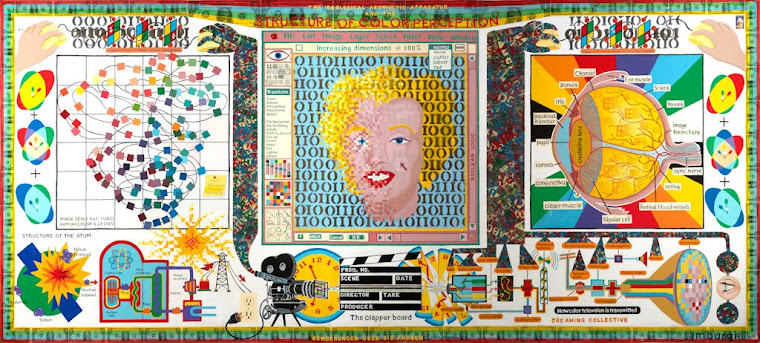
acrylic on board 48'X96'

"Structure of Color Perception"

"Structure of Color Perception"
48'X96' acrylic on board

Thursday, March 6, 2014


I was surprised that my friend Peter had posted one of my old poems on facebook along with this new amazing drawing of his.  I had not only forgotten this poem but I didn’t even have a copy of it!  Other than my friend DanO/M who put one my poems in his book I don’t think I have ever gotten (sort of) “published” before, even in a FB post! (college chapbooks don’t really count, they are sort of obligated to include you). Very much obliged y’all.

Saturday In Hell 

Let’s stop pretending that more words
Can change anything now
Even if we had faith once
Most wait their entire life
Wrapped up tight inside their tombs
For someone to command them
Come forth

It’s not the harrowing words
Themselves (if words have ‘selves’)
More like the hydraulics of
A great reservoir of power
Breaching the dike because
What gets funneled though spigots
Can not contain the force of flow
Against all our calculations
The numbers lied

Ashes and dust are more than the
Reckoning of bodily fluids
Signing the history of fire
Our own dried tears testify
No combination of
Incantations or sing-spells
Will roll the stones away
Nor lure us staggering into the light
Still bound in bloody rags

Here is Peter’s drawing.  I am thinking about maybe taking a crack at making a sculpture from it.  I’m not a sculptor, and I haven’t really had any training and I don’t know if I have any talent for it, but I don’t let that keep me from writing poetry or painting, so why not?  Anyway, here is one of my other sort of Lenten poems as well called "Pieta." 


Pieta

The authorities in Rome have
Erected a barrier of bullet-proof glass
Around Michelangelo’s Pieta
Still today some become so enraged
At this dead and pierced through little Jew
They try to smash him with hammers and bullets
Even as he lay in his mother’s arms
He can never be be dead enough
To please his enemies, and
Many of his friends

Obliged and blessings. 

Thursday, February 27, 2014


“If the butterflies in your stomach die, send yellow death announcements to your friends.” Yoko Ono.  

Most artists (painters, poets, writers, musicians, singers, actors, pastry chefs, quilters, pretty much all children, and the guy at the recycling center that sorts plastic) crave attention and recognition.  One way artists often try to get this fix of attention is by “shocking the public.”  Usually that means making use of nudity, blood, piss or nailing something to a crucifix (or a combination of all of these) which like Pavlov’s bell gets conservative christians riled up and marching off to another mutually profitable “culture war.”  But, ‘Is it even possible anymore for art to shock the public?’ This was a question asked in an article in the Guardian “culture” section.  What got them asking this was the performance piece of artist, Elani Sininger, a student at Northern Kentucky University, who decided to “create art in collaboration with people on the street.” She stripped half-naked in Cincinnati and lay on the floor with a sign that asked people to “write their secrets, confessions and general thoughts on her body” (no blood or crucifix thankfully).

Sininger’s stunt got me to thinking about Yoko Ono’s 1964 performance called “Cut Piece” (and no, I don’t blame Yoko for the Beatles breakup, Yoko was a serious experimental artist and cultural critic of some stature before the Beatles became superstars).  In this performance Yoko sat on stage and allowed members of the audience to cut away pieces of her clothing until she was made naked.  Of course there are a variety of ways to interpret her performance and it is reasonable to ask wether it challenged the cultural discourses around women’s bodies as objects of desire or merely reinforced the worst of them.  I reckon that today this kind of performance would mostly be understood as just a hollow stunt/marketing gimmick to increase ones market-share of visual cultural/capital (Miley Cyrus etc.).  But in 1965 I think that it took great courage to perform this act of self-disclosure, vulnerability, and confrontation with the machinery of phallic driven spectacle.   Afterwards Yoko said: “People went on cutting the parts they do not like of me until finally there was only the stone remained of me that was in me but they were still not satisfied and wanted to know what it’s like in the stone.”  By that I think she might have meant that after she was stripped bare, many put down their scissors and started furiously smashing at the stone for challenging the scripts of their false selves and the patriarchic foundations of this pathological culture.  Of course, doing that sort of thing can sometimes get one nailed to an actual cross.  Then again, I have painted dozens of icons of crucifixes and there is nothing the least bit shocking about them anymore, especially to christians.

Much obliged.
Btw, Yoko’s last performance of “cut piece” was in 2003 when Yoko was 70 years old.

p.s. if the video is blocked here is the youtube link:  https://www.youtube.com/watch?v=Zfe2qhI5Ix4&feature=player_embedded

Thursday, February 13, 2014


This music is for my Serbian Orthodox family.

Klediments:   The whole earth is a living icon of the face of God."  St. John of Damascus

“My brother asked the birds to forgive him; that sounds senseless, but it is right; for all is like an ocean, all is flowing and blending; a touch in one place sets up movement at the other end of the earth. It may be senseless to beg forgiveness of the birds, but birds would be happier at your side – a little happier, anyway – and children and all animals, if you were nobler than you are now. It’s all like an ocean, I tell you. Then you would pray to the birds too, consumed by an all-embracing love, in a sort of transport, and pray that they too will forgive you your sin. Treasure this ecstasy, however senseless it my seem to men.”  Dostoevsky, The Brothers Karamazov.


The condemned
 “What is the anarchic arche at the heart of all this disorder?  And instead of asking whether some intelligent being must not have designed it, I will ask whether some something amorous must not have loved it?”  Caputo, The Weakness of God.  p.14

Two things on the screen caught our attention when I was home with my wife because of a bad cold.  One was the report of the public killing/culling of a young giraffe at a Danish zoo. “The young animal in question could not contribute to the future of its species” according to zookeepers.  After a public execution and autopsy, the giraffe’s body was then fed to the zoo’s lions.  There is such outrage (and my own ineffectual queezyness) over this event that death threats have been made to zoo personnel.  In many of the articles and comments that I read about this “murder,” one phrase that recurred was that zoo officials had ‘no right to play god.‘  It seems to me though that much of what humans do could be spoken of as a kind of ‘playing god.‘ And that includes capturing animals and imprisoning, force breeding, displaying, and selectively killing them for entertainment and profit in the first place.  But why is it that when humans are accused of ‘playing god‘ it’s always a negative thing, a pantomime of god’s apparent capriciously destructive and vengeful characteristics that we have imposed upon god?  If someone sacrificed part or all of their life to save another person or other living creature (or planet) couldn’t we say that that person was also playing God?  Don’t many religious traditions instruct human beings to do just that?


Anyway, the second thing was the documentary movie “Blood Brother” that I ardently recommend (with a few reservations).  The documentary focuses on Rocky Braat, a quite ordinary young man from Pittsburgh (ordinary also in that like so many others he was abused, abandoned, neglected as a child). Rocky moves to India, encounters by accident and then takes up permanent residence with an orphanage full of children who are HIV positive.  My nose and eyes were already watering from my cold, but my bouts of weeping as I watched this movie put me in need of I..V fluids by the time it ended.  Not that there isn’t a great deal of humor and joy in the movie, but keep kleenex handy.  Interestingly (and refreshingly) the movie virtually never mentions god(s), religion, theology, theodicy, or metaphysics, we just witness a person ‘playing god‘ so to speak to a bunch of outcast, sick, and dying children who their society has determined, 'could not contribute to the future of their species.'  In one case Rocky ministers day and night to one small dying boy in the hospital for 40 days and nights, and the boy (miraculously?) recovers.  Rocky’s friend who did the filming proclaims that it was a miracle from God, but all the Indian doctors agree that Rocky saved the boys life.  I'm joyful either way, but I don’t know why it couldn’t be both?  Can’t even God play God sometimes?

Obliged.

p.s. if the youtube plugin doesn't work here is the link:    https://www.youtube.com/watch?v=bXOGNYwSkSY

Wednesday, January 29, 2014

Yutu

The small Chinese moon rover, Yutu, just suffered some sort of malfunction and so he/she(?) live blogged his/her death as he/she slowly froze to death (?) over the lunar night. I had to search all around the internet to piece together most of Yutu’s final messages. A lifetime of Disneyfication has rendered me vulnerable to a kind of grief and mourning (and even tears) over the demise of faithful little Yutu (she really is the model of the perfect corporate worker, our Overlords should be pleased!). Meanwhile on our own dying planet millions perish without my noticing....

1/25/2013: Last messages from Yutu:

“Ah ...... I'm broken.”

“Able to look at the moon, but also to share with you, I've been very happy. In the near future on the moon will drop to minus 180 ℃. I do not know when can not be repaired, so, let me wish you all a Happy New Year in advance!”

“Although I should’ve gone to bed this morning, my masters discovered something abnormal with my mechanical control system. My masters are staying up all night working for a solution. I heard their eyes are looking more like my red rabbit eyes. Nevertheless, I’m aware that I might not survive this lunar night.”

Here the sun has fallen, the temperature dropped so fast. Tell you a secret, in fact, I do not feel particularly sad. I was just in their own adventure story...at least I was finally able to see the complete Earthrise!

“Mother Chang 3 [the mother ship] doesn't know about my problems yet. If I can't be fixed, everyone please comfort her.”

“If this journey is to be suspended ahead of schedule, I am not fearful, No matter whether I can be fixed or not, I believe I have left my masters much valuable information and experience.”

“Before departure, I studied the history of mankind's lunar probes. About half of the past 130 explorations ended in success; the rest ended in failure. This is space exploration; the danger comes with its beauty. I am but a tiny dot in the vast picture of mankind's adventure in space.”

“The sun has fallen, and the temperature is dropping so quickly...to tell you all a secret, I don't feel that sad. I was just in my own adventure story - and like every hero, I encountered a small problem.”

“Goodnight, Earth, Goodnight, humanity."

God bless you Yutu.

Chang'e 3, Yutu's mother alone now on the moon.

Let me also offer this sort of space related poem I have been reworking.  Eta Carinae is a actual star that I discovered was in the process of dying.

Dying For Beginners (a guide from the stars)

Eta Carinae: No. 4U 1037–60 (A 1044–59)

From the catalogue of dying stars
I chose Eta Carinae
To pray for
Experts are predicting her death
Within the next 3 million years
But her core is already collapsing
Ending this cycle of her life’s journey

She is beautiful
I have seen the pictures
It was Rublev the Russian astronomer
(Not Rublev the painter of God’s shadows)
That first described her beauty
Mapped the contours of her body
But also foretold her dissolution
And later reduced her to a numerical coordinate
It is harder to pray for a number

The Chinese once called her “Heaven’s altar”
Noting In the Book of Jin
That she was second in glory only to Sirius
But she was first named
‘The Vermilion bird of the North’
Her changing colors were believed to
Predict the future of our lives

Bandits from the north ringed the city of Jiankang
They demanded gold and young women
Or they would destroy the whole town
As the gate began to fall
And all in the city faced destruction
The brave young woman called Ming-huá:
Chose to sacrifice her life for her people
She Leapt from the high tower over the gate
Stretching wide her arms as she fell
Miraculously they were transformed
Into vermilion wings of fire
All witnessed the blazing flames and fiery embers
Tracing the arc-light of her flight through the night sky
Burning enemies to cinders and ash
Then she soared up into the near-eternal heavens
Nesting in the Northern sky
Where she still watches over her people, for now

There she has birthed her own offspring
A luminous blue variable
Together they dance as they die
Flinging into the cosmos all their matter and light
Giving their masses over to disintegration
A display never seen before by human eyes
Stars spiraling in a magellanic cloud of witnesses
As Sirius weeps for the loss

I am told by the doctors that
When she dies there will be
One magnificent burst of light that
Will outshine the entire galaxy
In that momentary flash
All her energy will dissipate
Transforming again into elementals
What makes stars what they are
Heartbreakingly beautiful

It takes 80,000 years
For light to reach us from Eta Carinae
But prayers travel faster than light
We have time to seek divine intervention
Even if what will happen has already happened
Time is no matter for a God
Of colliding galaxies and falling sparrows
It is a great gift and sorrowful burden
To be given a heart
That can mourn the death of stars
Like our own mothers

Much obliged.


Wednesday, January 15, 2014


Ben Myers at the blog “Faith and Theology” posted a remarkable story about his family’s immediate experience of the accidental death of a 4 year old child.  The part of the story where his wife tried to breathe life back into the child as he lay in the road while Ben comforted the boy’s sister was the most emotionally intense for me.  How to be with the survivors of tragic death is a question we shouldn't have easy answers for.  I think Ben’s story does excellent work in exposing us to the painful complexities of these kinds of tragedies.  I have been on many sides of the story of death though (even my own) and there is something that is not mentioned in Ben’s story (but who knows, maybe that is for the best?).  There can be a kind of base devolution of one’s cognitive faculties when you stand by the bedside of your own dying child or at the funeral of a grandchild.  Another strange manifestation of yourself can seem to emerge from some dark distant epoch.  I am tempted to use the word “primal” to describe this but I’m not sure how much I want to believe in that.  We sometimes catch a glimpse of this strange beast at various times.  Like Ben, I have also been at the deaths of other people’s children, and God help me but I could not repress the intense feeling of being thankful that the dead child wasn’t one of mine.  I have also been so sure that the parents of dead children could see that shameful thankfulness in my eyes that I would avoid encountering the faces of grieving parents as much as possible.  But of course they probably already knew or could sense what I and other parents were feeling, just like I knew when people avoided looking into my own pleading eyes.  Perhaps more despairing and frightening is the thought that the dead children of others acts as some sort of sacrifice that just might appease the angry gods for a time and make my own children safer from the petulant vengeance of an angry god.


I have been watching the new TV series “The Vikings.”  I don’t really recommend it but the last 2 episodes deal a lot with religion and death.  I can’t speak to how historically accurate this show might be but I sometimes find myself uncomfortably identifying with their pagan religious compunctions and practices.  For all of the complex theology that we Christians have composed and compiled from Ignatius of Antioch and Augustine to Barth and Von Balthasar, I’m not sure that there is a profound distance/difference between the religion of these pagan Vikings and most of what passes as Christianity, at least at the emotional and practical levels of being.  In this show, the vikings tearfully plead before large wooden statues of their gods for the lives of their children, they beg for bountiful harvests, they bargain for profitable business ventures, and pray for victory at battle and the death of their enemies. How different is this from most historical american religious practice--except that their human sacrifices are named as such, and ours are often hidden behind metaphors and allegorical spectacles. And when their children died, their crops failed, or they lost at war, these pagans asked the same questions that most of us ask: where was god?

"Soon afterwards Jesus went to a town called Nain, and his disciples and a large crowd went with him. As he approached the gate of the town, a man who had died was being carried out. He was his mother's only son, and she was a widow; and with her was a large crowd from the town. When the Lord saw her, he had compassion for her and said to her, "Do not weep." Then he came forward and touched the bier, and the bearers stood still. And he said, "Young man, I say to you, rise!" The dead man sat up and began to speak, and Jesus gave him to his mother. Fear seized all of them; and they glorified God, saying, "A great prophet has risen among us!" and "God has looked favorably on his people!" This word about him spread throughout Judea and all the surrounding country". -Luke 7:11-17


Much obliged.

Tuesday, December 31, 2013

The Holy Family
By Father John Giuliani


Matthew 2:13   “Now after they had left, an angel of the Lord appeared to Joseph in a dream and said, “Get up, take the child and his mother, and flee to Egypt, and remain there until I tell you; for Herod is about to search for the child, to destroy him.”   Shall we pray that Jesus gets away?  


This weekend marked the lamentation of the Holy Innocents (children killed by Herod’s henchman), the feast of the Holy Family, as well as the anniversary or the massacre at Wounded Knee.  If you are actually interested you can look all that up on wikipedia.  Even though I wrote another of my insipid and usually passed over 1500 word responses like I have been doing every year to blog here or post on facebook, I decided  not to post it or any graphic pictures of frozen corpses of dead Lakota children either.  I am just too weary of all of this kind of discourse.  Sure many of my limousine liberal friends would “like” and share in my ineffectual moral outrage.  And most of my conservative friends would politely roll their eyes and say to themselves “well there goes Daniel again whining about dead Indians or dead whales or Yemeni children killed by drone strikes or whatever....” and of course nothing and no one changes.  The waters rise and children die, and the seeds of our next war or genocide are already germinating, sprouting, even as our last two hot wars wind down and all those dead, wounded, and maimed are quietly forgotten.  No amount of logical and reasonable argument or witty memes or bible verses seem to have any actual effect on us--especially bible verses.

I don’t know if it is even possible for an american like me (white, privileged, male, hetero) to read the bible or recognize the movements of the divine Spirit with any understanding.  We children of the empire are so insinuated into it’s consciousness and ideologies how could any words of life possibly break or seduce their way into our hearts and minds?  Our suffering and oppressed liberationist sisters and brothers have said as much and I believe them...I mostly want to believe them.  I wonder if that is why I read and others compose so much cleverly brilliant theology.  Is it in order to compensate for a lack of any transforming understanding and to buffer any encounter with meaningful and revolutionary truth?  How much of the spiritual/religiously labeled stuff that I do (including clogging up the facebook newsfeed with my rants) is an attempt to fill up or escape from an unbearable silence, or to hide from and even more threatening soul changing encounter with such profoundly simple words such as “Blessed are the poor,” or “Love your enemies,” or even “love...thy self.”  These phrases are so domesticated and distorted I despair that I can ever begin to know what they mean.  But I have stood by the mass grave of the murdered at Wounded Knee many times and I know this much; those words should never mean that.    

We americans have perfected an entirely new post-modern genre of fiction called “reality.”  And the ‘real’ fictional characters of this imaginary “reality show” that we pattern our lives after seem closer to us, more desirable and substantial, than some aphoristic and surreal character from a tragic bible story.  But the empire, the principalities and powers of this world, never stop hunting for Jesus and so all those mostly poor and dark skinned Rachels never stop weeping for their dead children.  I just stop caring or listening.

Much obliged


P.s.  Just in case anyone does want to actually study Wounded Knee further let me offer this review/mash up of quotes etc, of this excellent book “Wounded Knee: Party Politics and the Road to an American Massacre.” by Heather Cox Richardson (New York: Basic Books, 2010).  It is one of the best on Wounded Knee and the politics of genocide.  Once one understands Wounded Knee the insights gained from that incident can be applied to most of the genocides/colonial wars of america’s past, present, or future and those of most other countries as well.  This particular massacre though occurred under the administration of pres. Benjamin Harrison, who believed that his presidency (like so many others) was ordained by God, and he was an ardent supporter of the interests of big business and western expansion.  The ”Illustrated Newspaper” owned by Frank Leslie was the main propaganda tool used by the republican party and by the early 1880’s (think of it as the “Fox News” of it’s day and how Fox (as well as the NYT) was instrumental in promoting the war in Iraq) and it seemed that a triumph of republican industrial economic ideology was possible.  But Harrison needed western voters in order to maintain republican power and they hoped that supporting statehood for western territories would produce republican majorities there.  So Harrison opened up Dakota reservations to white settlements in the early 1890’s and of course the railroads and settlers poured in. for years Harrison and other party operatives continuously exaggerated or invented stories about the Indian threat to settlers in order to incite whites to demand more soldiers to be sent to the territories.  More soldiers and forts brought capital from the east to the territories and was instrumental in winning support for Harrison.  A similar strategy was used effectively by democratic Pres. Andrew Jackson and his ‘Indian Removal Act” of 1830 which was effected in part to win southern voters to the democratic party, a policy that along with support of slavery consolidated democratic control of the south until the civil rights era of the 1960’s.

In the fall of 1890, the administration of the Pine Ridge Reservation, one of six Sioux Reservations in South Dakota, fell to Republican agent Daniel Royer.  The new Ghost Dance Religion, a kind of gospel preached by the Northern Paiute mystic Wovoka of an imminent millennium that would deliver Native Americans from the sufferings imposed by the whites was spreading and Royer was worried that Sioux bands would incite an uprising and called for more military assistance.  As winter approached troops flooded across the Dakotas and on December 15 Sitting Bull, the famed leader of the Battle of Little Bighorn, was killed when agency police attempted his arrest. Sioux bands feared that the whites were planning additional arrests. Reservation leaders asked Big Foot, leader of the Minneconjou Teton Sioux, to come to Pine Ridge Reservation with his followers in hopes that together they could restore the peace. Intercepted by the Seventh Cavalry commanded by Colonel James W. Forysth on December 28, Big Foot's band made camp for the night about five miles east of Wounded Knee Creek.  On the following morning as the soldiers attempted to disarm the Indian camp of their few remaining hunting weapons the gun of one man who refused to give up his rifle went off and the fearful and inexperienced soldiers opened fire. ‘At least 150 Sioux men, women, and children were killed in the ensuing massacre (along with a still undetermined number of soldiers killed by friendly fire).  Babies were shot while still in their cradleboards. The army's Hotchkiss canons tore through wagons filled with fleeing human cargo of women and children, their bodies torn apart by the cannon's volleys.’ In the aftermath the massacre, Republican politicians attempted to clean up their mess. Through portraying the massacre as a "battle," exonerating Colonel Forsyth from wrongdoing, and awarding twenty of the soldiers with the Medal of Honor.

I ardently recommend this book for anyone who might want to know more about how power manifests itself in this world.  And yes I know that I have written an awful lot today about what i was not going to write.  Forgive me and much obliged.  

Monday, December 23, 2013

Digitally produced from Pankau art

“Their Eyes Were Watching God”

 "When God had made The Man, he made him out of stuff that sung all the time and glittered all over. Some angels got jealous and chopped him into millions of pieces, but still he glittered and hummed. So they beat him down to nothing but sparks but each little spark had a shine and a song. So they covered each one over with mud. And the lonesomeness in the sparks make them hunt for one another."  Zora Neale Hurston.

My holiday poem:  

#Xmas in Tinseltown

You must be as sick of it as I am
Talk about suicide or pancreatic cancer
Sure children die but must we dwell on it
And those crucifix’s everywhere...
Can’t this all wait till after the holidays
#idolatry#selfpity  

If we’re going to invent them
Why not make kind and yielding gods
Eager to fix what we break and then
Tuck away nicely into our fanny-packs
#personalaccessories

Superheroes are what we really want
Not grim anchorites sworn to silence
Invisibility is not much of a super-power
If you leave bloody tracks everywhere
#houndofheaven

Isn’t it time for fresh gods who aren’t bound
To old books and sunday mornings
Free-market gods tested by focus groups
Crowd sourced customized and tweetable  
#kickstarter#grouponforJesus

Branded deities that can compete on wall street
Survive the blood-sport of the trading floor
No more public subsidies for gods
Who can’t hack it in the real world
#renderingtoco-dependency  

Where fortunes are made amusing ourselves
With plots of planetary annihilation
Mega-industries inventing fantastic scenarios
Of extinction and doom
#Dionysian-Dithyrambs

Monstrous molecules invading our blood-stream
The dead risen and walking among us
Falling stars pulverizing capital cities 
Computer singularities conquering the noosphere
#blooduptohorsesstirrupsatmegiddo

Our new gods won’t require faith
Only the willing suspension of dis-belief
Children will still die but
Who will bother to ask why?
#IvanKaramozov

No need to rub-out the old gods
Look how wounded and pitiful they are
Leave them for the sick and useless
Let them all wither away together 
#plannedobsolescence

Let’s re-create paradise ourselves
Temples without sacrifice or virginity
Hyper-linked fractal liturgies
Bloodless virtual bodies
The stars, look to the stars
#Portfoliosofsouls 

Obliged and blessed holidays.  

Thursday, December 12, 2013


*** Klediments:

The Roman Catholic church has recently sent out a questionnaire to all the faithful.  I haven’t finished mine yet and after writing for 2 weeks I missed the deadline.  It’s hard to imaging any other church doing this sort of thing.  Here is a couple of examples of the kinds of questions being asked:   

Question 1a--4a: Describe how the Catholic Church's teachings on the value of the family contained in the Bible, Gaudium et Spes, Familiaris Consortio and other documents of the post-conciliar Magisterium is understood by people today? What formation is given to our people on the Church's teaching on family life?  4a: Is cohabitation ad experimentum a pastoral reality in your particular Church? Can you approximate a percentage?

In other words:  How many folks in your church are just hooking up and shagging like bunnies(and probably using rubbers to boot); and how many of y’all are instead sitting around studying papal encyclicals with unpronounceable Latin titles?  Oy vey.  Anyway, here is something I started writing on the back of the bulletin at mass on Saturday:


***  TRUE RELIGION™

"Stand at the brink of despair, and when you see that you cannot bear it anymore, draw back a little, and have a cup of tea.”  Elder Sophrony of Essex.

Mediating the existential void is perhaps the most important work of Religion.™  In performing that function Religion™ can be as destructive as many other kinds of mediation but when used as recommended Religion™ can be a safe and effective treatment for the symptoms of void-specific existential angst. 

(*WARNING: Mixing Religion™with other substances such as patriarchy, homophobia, machismo, individualism, materialism, nationalism, fundamentalism (or ‘isms’ of most any kind) may cause severe reactive disorders such as paranoia, oppression, the exploitation of others, hallucinations, racism, narcissism, and other painful symptoms that sometimes result in violent outbursts of physical aggression that in severe cases may lead to murderous wars and the establishment of empires.  Use Religion™only as needed and described by holy traditions, inspired scriptures, and/or direct encounters with Spiritussen Sancta.  Men who over-medicate themselves with Religion™are much more likely than women to suffer from severe side-effects such as irrational beliefs, conspiratorial ‘world views,’ non-specific outrage, denial of reality, and perverse addictions to books, alcohol, sports, pornography, pick-up trucks, duck-calls, guns, and other manifestations of erectile disfunction that in extreme cases reveal themselves as a compulsion for certitude and control sometimes known as “Hierarchical Dementia by Proxy.” If any of these symptoms occur stop using Religion™ immediately and consult your pastor, priest, exorcist, or an agnostic professor of German philosophy.  While Religion™may relieve the symptoms of existential anxiety, Religion™is not an effective alternative to faith, compassion, charity, forgiveness, solidarity, long suffering, justice, or grace.  However, when these substances are combined with Religion™ patients are often able to learn how to cope with and manage their fears and anxieties of death and nothingness in non-destructive and sometimes even positive ways.  Is Religion™the right treatment for you?  Have you dared to stare into the abyss but only found the darkness staring back?  Then Religion™prayer, and medication, may be the answers that you have been searching for.

Here is a link to the questionnaire:  http://survey.qualtrics.com/SE/?SID=SV_0pPsvi0vYPwodY9

And then there's this: 


*Caution there are very disturbing images in this video.”  This was posted on Facebook by an old friend of mine that I used to play music and sing with.  We have traveled different paths since then but I keep in touch because he is my conduit into a type of christianity that I like to keep tabs on.


Obliged y’all and you've been warned.                      

Sunday, November 17, 2013

"after crucifixion"  (with obligations to prof. Craig Keen)


*** Klediments:  

*** It seems that my blogging often functions as an archive for my facebook ramblings, I reckon that’s ok.  

*** “I would like to write like a painter.  I would like to write like painting.”  That is the first sentence in Helene Cixous’s “The Last Painting or the Portrait of God.”  I was re-reading my thoughts about Cixous’ words that I wrote almost 20 years ago and so I tried to create a painting in response to her instead of using more words and this mess of an image is what happened.  I painted this crucifixion outside late last night but alas it got rained on for about 15 mins before I got it under cover.  All the color bled out and into itself and so it has become a ruin.  This is the third recent painting I have had ruined in this way by rain since I can’t paint large 6X6 foot or larger canvases inside my little studio.  I will probably scrape it off tomorrow and maybe try again although I am somewhat discouraged and tempted to just stop all together.

Cixous’s essay seems to lament the power of painters (images) over poets (language) but of course when is it ever that straightforward?  She writes:  “All I can do is tell the desire.  But the painter can break your heart with the epiphany of a sea....  I am an awkward sorceress of the invisible:  my sorcery is powerless to evoke without the help of your sorcery.  Everything I invoke depends on your trust, on your faith.  And the painter?  Paints from hope to hope.  And between the two?  Is there despair?  Nonhope.  Between hope.....  But straightaway hope arises.”

Hope?  Nonhope? Despair? Like I said above it’s usually never that straightforward.  And sure I would really like to be a poet rather than a painter and I do work at it, but I just don’t have the crucial skills needed with words to write great poetry; too much of my language bleeds itself out.  In any event, I have been painting God’s portrait most of my life and I am no closer to ‘capturing‘ it now than when I started (oh how I loathe the metaphor of ‘capture‘ in the context of images).  How very vain and foolish I have been.  And so with just a little rain all my work and life is bled out and washed away.  Cixous says it like this:

“All I will have done will have been to attempt a portrait of God.  Of the God.  Of what escapes us and makes us wonder.  Of what we do not know but feel.  Of what makes us live.  I mean our own divinity, awkward, twisted, throbbing, our own mystery--we who are lords of this earth and do not know it, we who are touches of vermillion and yellow cadmium in the haystack and do not see it, we who are the eyes of this world and so often do not even look at it, we who could be the painters, the poets, the artists of life if only we wanted to be, we who could be the lovers of the universe.  We who are bits of sun, drops of ocean, atoms of the god and who so often forget this.  We who forget we could also be luminous as light....but what we forget, the painter who sees God each day in the process of changing, does not forget.” 

Remembering can bring such suffering, but I would like to be a painter against forgetting.  Pray for that.

*** a poem by Frank O’Hara:

Why I Am Not A Painter

I am not a painter, I am a poet.
Why? I think I would rather be
a painter, but I am not. Well,

for instance, Mike Goldberg
is starting a painting. I drop in.
"Sit down and have a drink" he
says. I drink; we drink. I look
up. "You have SARDINES in it."
"Yes, it needed something there."
"Oh." I go and the days go by
and I drop in again. The painting
is going on, and I go, and the days
go by. I drop in. The painting is
finished. "Where's SARDINES?"
All that's left is just
letters, "It was too much," Mike says.

But me? One day I am thinking of
a color: orange. I write a line
about orange. Pretty soon it is a
whole page of words, not lines.
Then another page. There should be
so much more, not of orange, of
words, of how terrible orange is
and life. Days go by. It is even in
prose, I am a real poet. My poem
is finished and I haven't mentioned
orange yet. It's twelve poems, I call
it ORANGES. And one day in a gallery
I see Mike's painting, called SARDINES. 

Obliged


Monday, November 4, 2013

"Trinity"  60X48 in.  Acrylic on board 1993

“To photograph people is to violate them, by seeing them as they never see themselves, by having knowledge of them that they can never have; it turns people into objects that can be symbolically possessed. Just as a camera is a sublimation of the gun, to photograph someone is a subliminal murder - a soft murder, appropriate to a sad, frightened time.”  Susan Sontag, “On Photography.”
Klediments: 

***  How much of art making is a way of claiming power over the imaginations of those who serve, over those who rule, over the gods of nature, and even over death.  This is one of the great temptations of artists and one that ought to be continually examined.  Of course death will end the artist’s will to power but does it break their hold on simulacra and illusion?  I wonder if the will to power and the denial of death are not to some degree behind every image we make, even the simplest snap-shot taken with our phone cameras and then instantly messaged or posted on Facebook.  How much of our ‘on-line‘ presence isn’t just a kind of digital embalming of our false selves?   

Of course, we might ask the same thing about language.  One of the great iconoclastic interlocutors of Saint John of Damascus’ (an ardent iconodule) argued against the use of icons writing that, ‘...images enter the mind unimpeded by reason.‘  He also argued (I write “He” because his name is lost to history, as we say. That is, he was killed and most of his writings were burned by the church) that it might be possible to allow some limited use of icons within the confines of a church building where the images could be carefully administered and constricted by language and doctrine.  Saint Johnny D rebutted the iconoclasts by writing that if the human nature of christ is unrepresentable then isn’t language about Jesus also idolatry?  For many Orthodox icons are often given a similar authority as the bible and engaged as another expression in which divine and human forms and actions become blended.  In any event, like most important theological issues, the real arguments about icons in the 6th to 8th c. and later on in England and Europe had much more to do with the control and distribution of power and resources, control of trade routes, access to raw materials, etc., than it did with semiotics or any obtuse doctrines about the hypostatic union or analogia entis.  

***  “Man is created in the image of God and God’s image cannot be captured by any human machine. Only the divine artist divinely inspired, may be allowed, in a moment of solemnity at the higher call of his genius, to dare to reproduce the divine-human features, but never by means of a mechanical aid! Here, in all its ponderous vulgarity, treads forth the philistine notion of art, dismissive of every technical consideration yet, sensing its doom as the new technology makes its provocative entry. Nevertheless, it is this fetishistic, fundamentally anti-technical notion of Art which theorists of photography have tussled for almost a century without, of course, achieving the slightest result.”  (Walter Benjamin- A Short History of Photography).


*** When the first human drew a circle on a cave wall and named it the sun, that cave became a church and the artist became a priest, and then the hunters feared her because she took for herself some of their power.  And so the warriors came to her before every hunt and battle to bless them and to give them strength and take away their fear.  She drew pictures of the hunters on the stone walls for them, and then she drew a great beast with a spear through it’s heart.  After that she drew a roaring fire in ochres and reds that so amazed the people that they were afraid to touch it lest it burn them.  And around the fire she drew all the people dancing and feasting, and so the hearts of the hunters were filled with courage and the minds of the people were at peace.    

But when a beast escaped, or hunters were killed and the people went hungry or they were attacked by other tribes it was then that the priest proved just how much power she really wielded. For In this world of constant threats and dangers where humans are just one among many small, naked, and vulnerable animals whose survival rests on innumerable contingencies and unknown dangers over which they have limited control, fear rules all emotions, life-ways, and affections.  But that same fear that compels vulnerable humans to live together in familial and interdependent communities also constantly threatens any forms of common life and mutual sacrifice; and so the people must continually make supplications for life to the gods of earth, water, fire, and sky.  Sometimes with words.  Sometimes with blood.

Whenever there was too much rain or not enough and the rivers flooded or ran dry, or when the migrating herds failed to arrive as expected, or when the ice and snow came earlier and lingered longer each year, or when the people’s enemies grew in numbers and boldness, then the priest would venture alone into the cave with only her instruments of charcoal made from fire and wood, and pigments distilled from earth, rock, and sacred flora.  It was only she who  would dare to speak to the gods for her people, to stand in their place, to re-present them, to beg or to barter for life.  And if the priest could assuage their anger or stir them from their indifference or even arouse their pity, then the gods might choose to guide the priest’s hands as she translated and inscribed onto the cave’s walls what they would require to give the people victory over their enemies, success with the hunt, rain in season, and children that survived.

The people would kneel and wait at the mouth of the cavern where they witnessed shadows and light wrestling inside the dark hole.  They could hear the echoes of the moans and cries of the priest, but they also heard other voices and unknown tongues sometimes whispering, sometimes howling in rage and anger.  And when the priest emerged form the cave her bloody body was covered with indecipherable markings, colored lines and intricate glyphs, signs that the gods had spoken with her and through her.  She then gathered the people into a circle around her and led them in chant as she leaped and twirled choreographing (dance-writing) the messages from the invisible other-world that surrounds all.  The people were astonished and joining her they chanted and danced until all fear was exorcized from their hearts and so the people were awed and her power increased. 

*** Hebrews 1 v. 3, “Jesus is the radiance of the glory of God and the exact imprint of his nature, and he upholds the universe by the word of his power. After making purification for sins, he sat down at the right hand of the Majesty on high.

Acrylic on plaster.  2002 30X42 in.

God bless and much obliged.