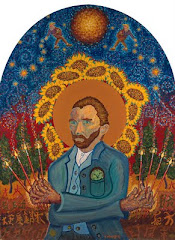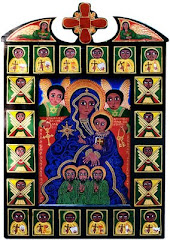
Exchange of Values

Exchange of Values
acrylic on board 48'X96'

"Structure of Color Perception"

"Structure of Color Perception"
48'X96' acrylic on board

Sunday, January 6, 2013


When Jesus Came the Corn Mother’s Went Away 
(a post-new-historicist prose-poem by Daniel Imburgia)


"Something has not yet arrived, neither at Christianity nor by means of Christianity. What has not yet arrived at or happened to Christianity is Christianity. Christianity has not yet come to Christianity."  (Jaques Derrida, "The Gift of Death." pg.29)


The original Madonna of the Wheat fields, the one I used as a model for my painting, “Madonna of the Corn Fields” above, is a fusioned depiction of The Virgin Mary created in Northern Europe by an unknown artist in the 15th century that I saw and remembered on one of my travels.  Her long flaxen hair, gold blouse, and white skin were set against, but also had much correspondence with the background of a harvest yellow wheat field and treeless horizon.  She is probably an amalgam of the Germanic goddess Fulla or maybe Hariasa and the Virgin Mary.  Such amalgamations are routinely condemned but I think these spiritual miscegenations and the power relations among colonizers and indigenous are often more complex than many more simplistic narratives account for.
One notices though that she is not called  the ‘Maddona of the Sacred Forest,’ or ‘The virgin of the Holy Tree’ perhaps because the wounds of the bloody struggle of Christianity against the Norse pagans and their demonic rituals at ‘sacred groves,’ and their idolatrous ‘tree worshipping’ were still too raw.  In any event, a compromise allowing the adornment of yule trees into the home once a year coupled up with the birth of the God-man Jesus was worked out and since World War II the Norse pagans, for the time being, seem to be peacefully accepting this arrangement.

Perhaps the greatest account of these recurring myth’s about sacred trees is the one about Yggdrasil.  She was an enormous tree located in what they of course called the ‘center of the world,’ she was really thought of as a “World Tree,” as it was sometimes referred to in their worship.  One can read about this extraordinary tree in a long prophetic poem called the “Poetic Edda.”  Here is just a sampling:

Hearing I ask, from the holy races,
From Heimdall's sons, both high and low;
Thou wilt, Valfather, that well relate
Old tales remember, of men long ago.

I remember yet, the giants of yore,
Who gave me bread, in the days gone by;
Nine worlds I knew, the nine in the tree
With mighty roots, beneath the mold...

An ash I know, Yggdrasil its name,
With water white, is the great tree wet;
Thence come the dews, that fall in the dales,
Green by Urth's well, does it ever grow.

On all sides saw I, Valkyries assemble,
Ready to ride, to the ranks of the gods;
Skuld bore the shield, | and Skogul rode next,
Guth, Hild, Gondul, and Geirskogul.
Of Herjan's maidens, the list have ye heard,
Valkyries ready, to ride o'er the earth.

I saw for Baldr, the bleeding god,
The son of Othin, his destiny set:
Hard is it on earth, | with mighty whoredom;
Axe-time, sword-time, shields are sundered,
Wind-time, wolf-time, ere the world falls;
Nor ever shall men, each other spare.

Fast move the sons, of Mim, and fate
Is heard in the note, of the Gjallarhorn;
Loud blows Heimdall, the horn is aloft,
In fear quake all, who on Hel-roads are.

Yggdrasil shakes, | and shiver on high
The ancient limbs, | and the giant is loose;
To the head of Mim, does Othin give heed,
But the kinsman of Surt, shall slay him soon.

And on it goes for 150 pages or so.  Let me give you the short version as I understand it from the Voluspo in the Codex Regius:  Top god Othin to avoid the destruction of the world calls Volva the wise woman from the grave who recounts the creation of the world and all the various peoples, dwarves, wanes, the first man and women, etc., and she also cleverly reveals how much smarter and wiser she is than Othin by reading his thoughts and then revealing a prophecy about the final battle and destruction of the gods and the world itself in flood and fire.  Pretty standard mythological stuff all in all.  Then it recounts how all nine of the gods meet under the great tree “Yggdrasil,” the “World Tree” this mediator between earth and heaven to work out how to save the cosmos.   Skipping ahead we meet the Valkyries who bring heroically slain warriors back to Othin to continue to wage the battle.  But Othin is killed just the same and so is the bleeding boy-god Baldr and yadda yadda eventually a new and beautiful world rises on the ruins of the old.  Anyone who has watched the movies Avatar, Gladiator, Lord of the Rings and seen Wagner’s Goterdammerung (or at least Francis Ford Coppola’s Apocalypse Now) will understand the gist of Norse myth, and some of Christian myth-making as well.   

Of course what was missing in the movie Avatar was the on-board chaplain and the blessing of the gun-ships etc..  Although, in 2153 as today, the Chaplin would probably not be a Franciscan friar but an Evangelical/falangist/NRA lieutenant hired by the RDA corporation to provide spiritual guidance to the soldiers and the ship’s crew and assure them that their real mission on Pandora was to save the souls of the tree worshipping Na’vi for Jesus.  And if a bit of unobtainium or low sulphur crude oil finds it’s way back to the mother country, well, where’s the harm in that?

Coincidentally, the Poetic Edda leaves off just about the time Saint Boniface, the “Apostle to the Germans” shows up in Germania with his axe and his bible!  Boniface made many evangelizing trips to Germania but what he is most remembered for is when he laid his axe to the base of the great oak called “Jove’s Tree” or (Jupiter’s or Donar’s Tree) and with one stroke and some divine intervention the greatest and most sacred tree in Europe came crashing down in the year 754.  The pagan witnesses who had been counting on their war-god who sometimes dwelled in the tree to help them kill and drive away the Christian invaders lost all heart and hope and mostly converted en masse to Christianity.  The wood was not altogether wasted however, it was sawed up and used to construct a church to commemorate the victory of Jesus over Jupiter!  Oh for sure there were a few enraged holdouts against this ‘blasphemy,’ just like there are still some Lakota who are still angry about their most sacred mountain defiled and desecrated by having the gigantic faces of four american president’s of the united states carved into it, and who unblinkingly glare down and remind the natives of their subjugation and oppression.   But for the most part the Germans fell into line and started killing in the name of Jesus instead of Thor or Odin or Jupiter, and the borders of civilization and the light of christianity advanced a few more leagues into the dark forests of sin and ignorance (*note, a few of those disgruntled pagans caught up with Boniface some years later and like at the battle of the Little Big Horn at Custer’s last stand, Boniface and 52 monks were killed, that is, “martyred in retaliation for murdering Yggdrasil ).

Now I confess to my devotion to the Mother of God, Virgin Mary, the “Theotokos” or “God-bearer,” and as a Christian I pray to her often.  I know this mystifies many of my protestant brothers and sisters (and some family members too LoL).  I suspect some of them see me no differently than some tree worshiping Norse pagan and would gleefully take an apocalyptic axe to the root of all my Popish superstitions.  I used to discuss this with my wife Lynda’s adopted grandmother Lydia Haas on the Pine Ridge indian reservation when we would visit (she died a year ago at 96 years of age!).  She was very understanding because she too had creatively blended her Catholicism, the wisdom of her Lakota religious traditions, and even a bit of protestant evangelicalism into her religious cosmology.  It was not unusual for us to be attending a powwow and Grandma Lydia would be praying the rosary to the beat of the drum circle and slapping time on her King James bible annotated by Jimmy Swaggert!  In her long life filled with a lot of heartache and suffering she said that she would often call on Jesus, the Virgin Mary, Sister Teresa, as well as the spirit of Crazy Horse to get her through her tribulations.  She had attended a severe Catholic school as a child but had also asked Jesus into her heart as her personal savior while listening to the radio around 1956, and she had later also taken a trip to Rome in 1967 with a group of 18 other Roman Catholic Lakota women and Pope Paul VI had given them all a brief private audience and blessing!

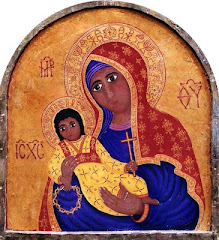
So it was in the truly ecumenical spirit of a wise Lakota Grandmother that when I decided to paint my version of the ‘Madonna of the Wheat Fields‘ I gave myself license to make some alterations.  As you can see she is dressed more in the style of a Mexican or Central american woman, her hair, skin, and eyes are dark, and the baby Jesus looks less like a bastard of  George Armstrong Custer and more like a child of an illegal alien being deported back to Guatemala.  This painting was inspired in part after I had read the book “When Jesus Came the Corn Mother’s Went Away: Marriage, Sexuality, and Power in New Mexico, 1500-1846.” By Ramon A. Guitierrez.  The book recounts the subjugation, oppression, murder, and conversion of the Pueblo Indians.  But it also speaks to their ability to resist and fight back, to force accommodations, and to both subversively and overtly inject and blend some of their profound cosmology into the kind of Imperial Catholicism they encountered.  And this struggle still isn’t over, not with the Pueblos or for many other tribes in north american and around the world.  The stories and wisdom of colonized peoples are still being told and retold as is the story of the catastrophe of their encounter with “civilization.”  There are lots of stories about the Corn Mothers and in many other tribes besides the Pueblo.  Here is one history recounted by Guitierrez: 

“After the Corn Mothers, Iatiku and Nautsiti, had lived on the earth together for a while they began to quarrel because Nautsiti was selfish and hoarded the things in her basket.  Because the sisters constantly argued, Nautsiti decided to leave her sister, taking with her the child she loved and her basket which contained sheep and cattle, wheat and vegetable seeds many metal things and something written.  Nautsiti offered to share these things with her sister but Iatiku refused to accept them saying that she “did not want her children to have them.”  So Nautsiti departed to the east and promised Iatiku that “in a long time to come we shall meet again and you will be wearing clothes.”  A women bearing a likeness to Nautsiti returned to the Puelbos in 1692, just as she said she would  Her name was Nuestra Semora del Rosari, La Conquistadora, (Mary Our Lady of the Rosary, Virgin of the Conquest).  In one arm she carried her infant son, Jesus Christ, and in the other she carried a rosary.  Around her were the things she had brought: Cattle, sheep, vegetables, metal tools, armaments, and writings.  Our Lady of Conquest returned to New Mexico on August 21,1692 carried by 60 Spanish soldiers led by Don Diego de Vargas, the reconquerer of New Mexicoas.” (pg 143)


Grandma Lydia had many paintings and statues of the Holy Mother in her apartment, more of her than of Jesus if one were tabulating up that sort of thing, and all of them were as white-skinned and blue eyed (and some were even as blond as) any of the Norse goddesses!  Which bugged the crap out of me with all that post-colonial and sub-altern theory under my belt but it didn’t seem to bother her in the least.  It was under the supervision of these Nordic Virgin's, and several of Lydia's neighbor women friends who were even older than Lydia, that she cut and sewed by hand for my wife Lynda a complete set of Lakota women’s regalia.  It is made from smoked deer hide, glass beads and porcupine quills, etc..  It was a long process and it took them all more than a year.  The bead work and sewing would be accompanied by prayers to Jesus and the Virgin Mother as well as to the White Buffalo Calf Woman and God only knows who else!  It is probably the most sacred and valuable thing that we own.  The picture above was taken 2 years ago by brother Christian Amondson at a powwow in Oregon.  It is of my wife Lynda dressed in that regalia.  But the only keep-sake I have left frm pine Ridge is a T-shirt from “Big Bats,” the one and only fast food restaurant at Pine Ridge, which seems to be doing it’s best to kill off as many Indians as possible by afflicting them with diabetes.  Oh, and I guess that I also have this poem I started back in 2004 at our last visit to see grandmother Lydia.  And shortly afterwords Jesus came to take her home and Grandmother Lydia was waiting for him with faith and joy in her heart.  But all too often in history a very different Jesus has invaded the lives of indigenous cultures and peoples, and it is that Jesus that Gutierrez records a Pueblo woman lamenting, “when Jesus came the Corn Mothers went away,” and it is that Jesus that this poem is about.      

In the Ending Was the Word

When Jesus came the Corn Mothers went away
When Jesus came the people learned to flee in terror
When Jesus came many people were captured and made slaves
When Jesus came Grandmothers were insulted and abused 
When Jesus came all the women were forced to wear strange clothes
When Jesus came local women healers were executed as witches
When Jesus came his followers stole all the skins from all the animals
When Jesus came our hunters were made to dig in the barren ground
When Jesus came they burned our village to build an oil pipeline through it
When Jesus came our children were taken and sent away to schools
When Jesus came his ministers and soldiers raped our children 
When Jesus came the sacred dwelling places of our Gods were torn down
When Jesus came his soldiers made us worship him at gunpoint
When Jesus came we were forced into prisons, camps, and reservations
When Jesus came we were made sick with diseases that we could not cure
When Jesus came they damned up the rivers and flooded our homes
When Jesus came the waters were polluted and made undrinkable
When Jesus came they would dig away our sacred mountains to find gold
When Jesus came we could not see the stars at night anymore
When Jesus came Earth became void and darkness again covered the deep

The coming of this un-named horror was sometimes spoken of as
The great and awful apocalyptic hurricane of history 
All the peoples of the world are caught up in it’s fiery vortex
All their monuments, temples and holy gathering places
Every fruit vine and seed bearing plant that is good and 
Even the oldest of the grand-father trees are
Uprooted and flung up into the dark funnel 
The rivers are stopped up, swallowed up, and run dry
The great waters are despoiled of life and made unlivable
Brother and sister creatures are swooped up and slaughtered
The great fishes of the sea, the swarms of flying birds
Even the dead are violently snatched from the earth and
Caught up into this desecrating storm
The words and sacred songs of the people become unspeakable
Unheard among the thunderous crushing winds
Exchanged for screeching gutterations of metals and money
No one people can stand alone against the power of this storm
All peoples are taken up and later cast down in strange places
Among unfamiliar lands without homes or sense of direction
And when those lost and struck down people gather together
They ask each other from where did this death-storm come?
And they asked each other what we should name this death-storm?
For none of the peoples had a word for such an alien destructive power
So they were forced to find a word among the language of the destroyers
And the word that they discovered was:

“Christianization”


Obliged


Sunday, December 30, 2012


Blessed New Year and let’s continue with more travelogue poetry. I looked through my old inventory and I don’t really have a painting that seems to really resonate with this poem.  In any event, I don’t want my painting to function as a pimp to my poetry, or the other way around.  So I just took this picture of my back work room where I discard unsatisfactory work, paintings I’m going to paint over or discard, ideas that didn’t pan out.  It’s also where I experiment, throw paint around, or melted wax, crayons, plastic.  Like that “Pocahontas See N Say” toy on the bottom left.  I exchanged the original pictures with photographs from the murdered Lakota at wounded knee.  Next I wanted to change the original recordings that said things like “Curious raccoons love to play,” or “Corn, the good earth gives us corn to eat,” or “Grandmother willow is a very wise tree,” with actual Native-American voices offering their own words and explanations about their experience with what we call “nature.”  That proved to be too technically difficult for me and so there it sits, still not art, not yet.  Next to it on the right is a Coptic angel of death that the squirrels that live in my studio have chewed some of the paint off of.  You would think that the sword would have kept them at bay, maybe if I was more of a realist I could have saved her?  But I reckon it’s not just painters that have places like this but also writers, poets, sculptors, duck call whittlers, even theologians, and philosophers all have back rooms where poems, theories, dogmas, and screeching duck calls are tossed away and best forgotten.  One step away from becoming more of a life's wreckage.  Behind my studio is a gully that I’m filling in and where I toss all of my organic and compostable matter.  If the squirrels keep at it, that’s where the angel of death is going to end up.    

Jerusalem, Stalingrad, Warsaw, Rome...

Like ships cities need scuppers
Means for whatever is not city to scuttle free
Holy redoubts where prophets weave our future
Sanctuaries in cliff faces, asylums
Where blood-money has no purchasing power
Vengeance is postponed
In the center of the Holy of holies
The manslaughterer purifies his hands
On the wings of cherubim

Because our name comes after the fact
From someplace outside these broken walls
Mothers keening for their children
Who are sacrificed in the bargain
Just as Shiloh and Sodom lost their glory
A women looks back
Whatever appearance held her gaze
The name of G-d still sleeps un-utterable
Encoded within babbles of consonant acronyms:
           Y  --  H  --  W  --  H
Four little peeks under G-d’s skirt

Then the walls were felled by the mean tide
All the guilty are found within--One people finally
For there is no more outside the text
No habitation or vantage to look back at ourselves
Everywhere the center is holding
Virgins were sought, none were found
Who could not be tempted to look back

Anyone with sense could see it
Was a catastrophe in the making
And never one to trust a mob
He preferred his own company and
Selling door to door
Yet after all this time we
Still haven’t given up on messiahs
We’re always searching for just the right kind of
Character, an ‘all things to all’ kind of personage
If there was a contest, a pageant, if there were a vote
At least a majority would have some satisfaction
As it is now no one’s really happy
No one that counts

Looking over the great cities one can imagine
Weeping, but not for the sake of the architecture
Which is all out of proportion to it’s reputation anyway
Stones never stay where you put them
Even when stacked high on the bodies of oracles
Kneel down with a poet’s ear to the mound
The Slightest breath escapes like tears
Between the cracks in the unmortared rubble

The panicked herd worn and exhausted stalls out
They are so beautiful, their lungs
Pumping steam into the cold morning
The lead mare paws the fresh snow, ears pricked
When the frozen trees crack like gun-shots
She bolts leading the murmuration
Instinctively she knows the herd will follow her
All the way to safety or into the abyss

Monday, December 24, 2012


This painting is an older one (48” X 30”).  The medium I used is mostly crushed rock, soils, flowers and plants that I collected at Pine Ridge Indian reservation when me and my wife used to visit and work with the elderly there every year.  We’d do simple things, like driving grandma to bingo at the Catholic church on wednesday nights and maybe fix up the trailer a bit, nothing much really as these things are reckoned.  It was there that I first saw what the Sioux and other plains tribes called a “Winter Count.”  It was a history of the years events painted on animal skins (see Colin G. Calloway, “One Vast Winter Count: The Native American West before Lewis and Clark.”).  About 100 of these old winter counts still survive, but many native artists are reviving the tradition and the work they do is incredible, and they inspired me to do the painting above.  It is interesting to place events recorded in these surviving winter counts, ‘the battle of Little Big Horn,’ for example, in contrast to newspaper reports and the ‘official’ history of the same events.


Then an article by John Crossan got me to thinking about my family’s visit in 1996 to the ‘Altar of Augustan Peace‘ in Rome, another kind of winter count.  Tapestries, paintings, bas reliefs, depicting the victories of Caesar Augustus over the enemies of the empire (the Hollywood of it’s time really).  It’s how a guy could work himself up to becoming a god back in the day, ‘war, victory, peace; war, victory, peace; repeat as often as needed, a proven recipe for success.  Still, among the vanquished, the victims, there are always counter-histories, subversive songs, poems, parables, subtle aposiopesis for those with an ear to hear, spread about by folks labeled rebels or even terrorists.  What actually happened, the official story, the Truth, gets all mixed in with the blood and muck and money so sometimes even now we have a hard time getting our stories straight.  

Blessed holy days y’all and here’s a little ditty I wrote for Christmas:

Xmas Year Zero

If were just figuring statues and portraits
Jesus is the victor
If it’s the body count that matters
Then It all depends....

Two kinds of coins
Two kinds of kings
Two kinds of gods
It’s a toss up really

We have yet to decide
Between the hand and the heart
There is waiting
And there’s just killing time

Our sympathies are with the straw child of course
The mystic, the martyr, the Jew
The humble one with the unconsolable eyes

But Caesar was a kid once too
‘Novus homo,’ destined for greatness by all accounts
His devout mother was favored by the gods
Guiding his first baby-steps towards divinity
Tested by a serpent in the temple of Apollo
She was marked with a rainbow that never faded
Her womb was assumed into heaven
Signs in the stars confirmed the miracle
Great victories on the battlefields of Thurium 
Slaves, peasants, and the enemies of the law crushed
All the testimony is there in the records
The word conceived on parchment and calf-skins
Scripture in the making

But If we’re just adding up kapital
Shopping days and time off from work
The seasonal consumer index
Then the ‘son of god‘ has triumphed
I mean the one from Palestine
If we're just voting with our lips
Not accounting for feet or dollars
Believers and not actual followers
Then the Nazarene wins by a mile
But if it comes down to swords into ploughshares
What is actually rendered unto
Then it all depends...

There’s what we hail as peace, pax, pacem,
And then there’s order, obedience, pacification
Our hearts lie with the lamb
But we bank among the lions

Blessed Holy days all, much obliged.

( the link to the article: http://www.huffingtonpost.com/john-dominic-crossan/the-challenge-of-christma_b_1129931.html ).


Thursday, December 20, 2012


This painting above is 9 feet wide and 4 feet tall. I wanted to reproduce some of the last surviving words, poetry, names, and art left on the walls of Auschwitz.  I Reconstructed it from photos and charcoal rubbings, etc., all the images I gathered together and then painted there are exact replica’s of the originals to the best of my ability.  Obliged.


Poem of the week:

A Little Ditty of a poem started in 2006 when we were on our way to Beirut from Haifa.  Turns out that the Israeli air force had blown up all the bridges in Southern Lebanon and the car rental place wouldn’t let us take the car over the border.  In any event a big chunk of Beirut had been blasted to smithereens.  But the great thing about religion, myth, poetry, is that it can take routinized destruction and death and turn it into a mythic story of profound meaning.  Like some of the stories in the bible that were shaped and rewritten over hundreds of years, sometimes thousands, before an armistice was agreed upon and one account was declared victorious, for a time.  Nowadays, that whole process takes less than a week of television or chatter in the blogosphere, and maybe just a day on facebook?  Martyr’s square in central Beirut is a place where one can watch this process unfolding.  Locusts, plagues, war, starvation (the end of a world really) killed many Maronite Christians and Muslims as well as a lot of people called “intellectuals.”  Then Revolt, counter-revolt, retribution, execution, etc., Ottomans, Brits, French, Jews, Wahabi’s and what not. It’s hard to keep the whole thing straight in our minds.  Scripture in the making, but it’s going to take some centuries to hammer the thing into shape.  They put up a huge statue of a guy right in the middle of the square to mark the infamous day of slaughter for all eternity but nobody I asked knew who he was or what he did, even wikipedia doesn’t mention who the guy was supposed to be though I can download a picture of the top of his head from outer space.  True, his face has been hacked and shot away over the years by just about every political group imaginable but you would think that folks would be curious about a huge chunk of battered bronze plopped down in the middle of their city.  We’ll just have to wait I reckon, that statue may have started out as a Marxist Baathist like Zaki ai-Arsuzi, and then wind up being a Catholic saint like alfred Delp!  Obliged. 

Tempus Fugit


The end of the world is always now somewhere
For some it was friday last
For others it was 1492 or 1942, whatever,

Still, I’v been to Quitana Roo

Time itself is not the scandal there it is here
It’s not a self at all

Time there is tracked, captured, sacrificed, worshiped,
Bled-out, never escaping it’s captors
There are too many traces left in tears and blood 


Something’s going to get us for sure
Even the ancients knew that much, but
No one has ever won betting against death, not yet 

But you don’t make calendars out of 
piquin chile and chocolate
Not if you want to survive to read your own horoscope
And avoid becoming the laughing-stock of history

Scratch your questions, prayers, complaints

Onto something concrete and don’t be specific
A wise prophet always leaves some wiggle-room
The “Book of Revelations” is a good example 

Deserving has got nothing to do with it

If that means getting what we got coming to us
Revenge has never been something to set our watches by
  
The gravity of our blunder beckons the heart of god from heaven
It plunges through the exosphere
On a Collision course with the world
Beautiful and terrifying we can only trace its fiery arc
Its downfall 

It’s not too late, there is still time to carve a message in stone

But the coming fire is already hot on our faces  
Hot enough to melt chocolate

Obliged.

Thursday, December 13, 2012


“The skin of the face is that which stays most naked, most destitute....[T]here is an essential poverty in the face; the proof of this is that one tries to mask this poverty by putting on poses, by taking on a countenance. The face is exposed, menaced....The face speaks. It is in this that it renders possible and begins all discourse.... The first word of the face is the “Thou shalt not kill.” It is an order. There is a commandment in the appearance of the face, as if a master spoke to me.” (Emmanuel Levinas, Ethics and Infinity  86-89)

I’m home sick and my wonderful wife is taking good care of me.  I'm watching the TV show  “Criminal Minds,” a group of FBI profilers that track down serial killers.  Adam Kotsko over at “An und fur sich”  <http://itself.wordpress.com/>  wrote a book on why we are fascinated by serial killers, but I haven’t read it.  I think I am afraid of what it might discover about myself.  This killer removes his victims faces.  To solve these crimes constructing intimate profiles of the victims is as important as that of the killer.  Why don’t we give people that much care and reverence before they are murdered, while they still have faces?  A drone strike from the U.S. killed an innocent family in Yemen yesterday.  I wonder what the profile of their killers would reveal?  Meanwhile I’m following some interesting facebook discussions.  One is on whether there is a hell or not.  I don’t think there is a hell, but I haven’t had my face peeled off by anyone yet.

What did sick people do before TV?  Well, I just wrote this poem below and posted it over on the Faith and Theology blog <http://www.faith-theology.com/>   Seems that interest in poetry is growing again and perhaps my advice will be helpful.  Then I put on the movie “Being Flynn” about a failed poet and writer (Robert DeNiro) who (stereotypically) ends up broke, depressed, homeless and living in a shelter without a friend in the world.  At least he’s not a serial killer ripping people’s faces off! (although he does say things that hurt other peoples feelings a lot).  I reckon my real fear is not failing as an artist or poet, but not failing tragically enough to be noticed or make a difference to anybody.  Well, I should get my fever down and then see how this movie ends before I do anything too impulsive or post anymore half-assed poetry or comments around the blogosphere.

Oh, that painting above is a bit of an experiment combining some of my other paintings and icons, I’m not sure what I think about it yet, please offer any criticism.  Be well and obliged.

Instructions On How To Read/Write Poetry:


First, do not get a hold of yourself
Accept unsolicited suggestions from strangers
Deny every syllable of immediacy
Whatever you have been running from your whole life
Turn and face it now
Make a pile of all your dictionaries, thesauri, scrabble boards
even your alphabet cereals, soups and crossword puzzles
Burn them, burn them all to ashes before you even start
This is not pointless destruction but an offering. It proves that
You are now ready to take language seriously
Decide if you believe in free will, then
Load your pistol and give it to someone along with your poems
Focus on the most obvious questions imaginable
Do not take a college course in ‘Poetry Appreciation’
Instead study the mysteries of micro-economics and
Become a collector of things made from alligator skins
Do not look outside the text or inside the text, look for magick
If theory will not save you, neither will punctuation
Deny Christ three times in one night, then wait for grace to come
Be always ready to laugh out load, ready to love, to kill
Ever ready to let a poet break your heart, bear witness
Never pay for poetry, it will entangle you in a cycle of gift/debt to
The poet that will only end when one or both of you is dead
Never try to delve below the surface, poetry is all surface
Think of the person you hate most in this world
Then put a curse on them
Imagine that your words have the power to make them suffer
Think of the person you love most in this world
Then pray for them
Imagine that your words have the power to bless them
Now exchange those two people in your mind, in your poem
Know up front that every word has already been spoken for
So you have to seize for yourself every morpheme available
(you should have all you need by age 8)
Do not “borrow” words from other poems, totally consume them
Make it so that no other poet can ever use them again
Poetry can be made out of almost everything, and almost nothing
Using obscure vocabulary, making oblique allusions depreciates poetry
“Hemopoiesis,” (to make) is the root of “hemaTopoiesis” (to bleed)
But etymology is not poetry, neither is tagmemics or taxonomy
(a real poet would know that instinctively by age 8)
Never take any advice on poetry from a poet
They are always out to scam you
When you think you know what poetry “means,”
Then you do, so quit


Obliged.


Sunday, December 2, 2012


This is my pregnant daughter Alyssa.  I posed her in front of my two paintings that were inspired by the discovery of the “God Particle” (or Higgs Bosun field). 

Two poems today.  The first poem I have been revising for a while.  Perhaps I am seeking absolution for spending so much of my life in “resource extraction industries” like King crab fishing in the Bering sea and logging the high country?  

There is still work to be done on these words, any criticism would be appreciated, much obliged.


The last Supper

The last whale comes to a dead stop
Waft, floating
And not hearing her song return to her
She lies still gray silent
Not accusing her maker for her circumstance
Even the last whale song is beautiful

Watching us from the beginning
Bobbing on the surface,
Splashing, laughing, crying, dying
Not Standoffish at all, for ones so small
Though it turns out that the entire ocean was
Not big enough

Technically speaking
We won’t know for sure when the last whale dies
The whale-killers will return from the sea empty handed
Another venture will be written off as
A loss on the balance sheets
The ships will be refitted to 
Hunt penguins or starfish or angels

Eventually, a marine biologist or 
Responsible government agency
Someone with authority
Simply states the obvious, ‘they are all gone,’ dead
Then it’s back to business as usual
Some family in Osaka or Haugesund will look up from their plates
Saying ‘had we known, we would have savored it all the more!’

One day the gods will come to notice how quiet earth is
No clamor of war, no prayers for more
And after seeing no lights on at night for awhile
Or being annoyed by harpooning rocket bursts they 
Will say something like, “Well, now when did that happen?’

Obliged.


Rapture

It’s always come easy to me
Thinking about death
I’m every bit afraid as a sinner should be
More than the sky gives me credit for

Part of it is the waiting game
Part is having my number just come up
Whatever can die aught to be called by name
In the vernacular of it’s own life

I would opt for a rapture every Jubilee year
Rather than one big fandango at the end
We need the space and there are people I miss
For some even three days seems an eternity

Mathematically the figures don't add up
We can see to the edge of infinity
Too calculate any farther might be blasphemy
But I’d like to take a crack at it from another angle

The sheer volume of the past is staggering
But the angel of history is not the same as
The angels of death
Only our time-pieces make it seem so

Weary virgins trim their wicks
The watchers seek the sign of Jonas
Far from the sea a pearl comes to light in a plowed field
Vows were made but never kept

We were promised:
‘after the first death there would be no other’
That’s what comes of listening to poets
Without them everything could be what it seems
Instead of all these literalists coming to a tragic end

Obliged.

Saturday, December 1, 2012


‘...after that he determined to only speak in parables.’

i reckon it’s about time I post some of my poetry
see what they look like on a different screen, in other’s eyes
get some things off my mind
you too can lay your burdens down here trusting
no one will ever be any the wiser

Disavowal 

On Saturday the old priest waits alone for their sins to arrive
Though he hasn’t spoken directly to god in fifty years
That is, used his own words, not language approved by authorities
Not a soul has stepped inside his dark box for three years

An old women had come in place of her dying husband, an unbeliever
She begged mercy for his sins, wanting to be with him in heaven
I can’t forgive the sins of someone who doesn’t ask directly he told her
Does that go for god too she asked him back

The year before that a man brought his children, but not to confess
“When I was your age I had to go in there an spew my guts out to a priest”
The children gasped, cautiously peeking through the dark curtain
When the old priest whispered “bless you my children” they ran away screaming

The retired old curate was pressed back into service to fill in for priest-less parishes
Lack of vocations, declining membership, criminal abuse, all had left vacancies, holes
Lay people did all the work of running things, keeping the lights on, the money counted
He was just needed to perform certain gestures, without that what use was he?

In 1963 He fell in love with a Sulpician nun, Sister Gemma Calgani, and he knew joy
She loved him too and they made plans to leave holy orders and marry
At the last, Gemma could not forsake her vows, and so god took her back
The old priest too, but he hasn’t spoken to god since

Once in an emergency he was asked to shepherd the ‘teen youth group’
He suggested they kneel and say the rosary together, but all they would say was Oh My God!
But they knew well enough how to talk with those inhabiting unseen worlds
Knew more of the rituals and codes of communicating with the invisible than he did

So mostly now he ministers to the dying in hospital and nursing homes
He is as old as they are, older, so they trust him, more than their children
They sense that he too will soon cross over and be held accountable, face to face
The prayers for the dying are on pages 7 through 34, right in the front of his book

Page eight. “Prayer for a Happy Death.” he knows it by heart:

O my Creator and Father I beg of you the grace of final perseverance and a holy death despite the fact that I have greatly misused the life you have given me grant me the grace to live it well from this moment on and to end it in your holy love Let me die as the holy patriarchs died, leaving this valley of tears without sadness, to go and enjoy eternal rest in my true homeland let me die as did glorious St. Joseph accompanied by Jesus and Mary pronouncing those sweetest of names and in whose company I hope to enjoy for all eternity Let me die as did the Immaculate Virgin in the purest of love and with the desire of uniting myself to You the only object of my love Jesus having accepted death for me, grant me the grace of dying in an act of perfect love for You Holy Mary Mother of God pray for me now and at the hour of my death and protect me from the enemyAmen.

Sometimes during Mass he would unconsciously slip into Latin again, a dead language
Called so because only the Church still makes use of it
He assured the parish council that the words were still authorized, efficacious
They wrote the bishop again asking for a replacement

The new priest was from Goa, dark, young, full of exuberance and fresh ideas:
Growth, outreach to young people, becoming relevant, modernization, fresh paint
The old priest had seen it all before, said something similar in 1951, 1963, 1980,
The new priest spoke with a foreign accent, but no one mentioned it or seemed to mind

As he was packing up news came that Sister Gemma had died, came by e-mail
Her real name was Cindy, but no one knew her by that name but him and god
He cried great heaving sobs in front of the computer, none of the staff knew what to do
The new priest said something about sun beams and energy fields, hard to say really

His last service was officiating at something called an ‘ecumenical celebration!’
Folks from all kinds of churches coming together, “Unity in Diversity” the banner read
He would have to share the altar with a woman pastor, no Eucharist, just a ‘service’
The parish secretary asked if that would be a problem for him, almost hoping it would be

No, the old priest said, I have always loved women


Obliged.

Thursday, November 15, 2012


Poem of the week is form Subcomandante Insurgente Marcos:

"Account of the Events" 

Today, the sixth day of the month of August
of the year nineteen hundred and seventy-nine
as history forewarned
the coffee bitter,
the tobacco running out,
the afternoon declining
and everything in place for
conspiring against the shadows and darkness
which obscure the world and its sun.

Some of you older folk may remember Subcomandante Marcos, the charismatic poet-warrior leader of the Zapatista’s in Chiapas so many of us radical poseurs were infatuated with (and so many others went to visit/vacation with after Daniel Ortega in Nicaragua got himself de-elected by Ronald Reagan’s falangist contras).  Still, they need the money and the media in order to continue to conspire against the “shadows and darkness,” long after our attention has been tweeted elsewhere.  Yet there is still something very inspiring and terrifying about a small community of poor campesinos living, struggling, and caring for one another, whose life together is lived out daily in the simple acts of feeding pigs, grinding corn, hauling water, invoking the Virgin and burying one another’s children.  From the windows of a moving bus heading through such actually existing communities of hope and desperation one can witness *the blessed poor* we so much like to conjure into our intricate and fantastical theologies.  Too much of my own theological ruminations smell more of ivy, new leather, and Starbucks than pigshit, blood, and Ningüijute to be taken seriously by anyone, obligado. 

p.s.  later in the document Subcomandante Marcos goes on to write to his friend Don Fernando: “Greetings from all the zapatista companeros and companeras and from the indigenous communities in resistance. We hope that you, and all of those working alongside you, are in good health and of good cheer. You, as we know, are working alongside other honest men and women in tending to the memory of our people's struggle.”   Then at the end comes this really quite jarring exhortation of commitment to the struggle and to solidarity.  The Subcomandante proposes that his followers sign a contract of sorts that bears a frighteningly amount of similarity to the gospel! 

“First. - That the below signed renounce their homes, work, family and studies and all the comforts which have been accumulated in the hands of the few upon the misery of the many.

Second. - That the below signed renounce a future, paid on time, of individual enjoyment.

Third. - That the below signed also renounce the shield of indifference in the face of the suffering of others and the vainglory of a place among the powerful.

Fourth. - That the below signed are prepared for all the sacrifices necessary in order to fight silently and without rest in order to make me, the patria, free and true.

Fifth. - That the below signed are prepared to suffer persecution, calumny and torture, and even to die if it is necessary, in order to achieve what was noted in the Fourth point.

Sixth. - That I, the patria, will know to keep your place in history and to watch over your memory as they watch over my life.

Seventh. - That the below signed will leave enough space under their names so that all honest men and women may sign this document, and, when the moment comes, the entire people shall sign it.
There being nothing left to be said, and very much to do, the below signed leave their blood as example and their steps as guide.

Valiantly and Respectfully, Subcomandante Marcos.”

I gotta say that this Evangelium hits me pretty hard.  And as you can imagine the list of names of those that signed was pretty short (and always has been).  Hasta la victoria siempre, obligado.

Monday, November 5, 2012


Klediments:  “More than at any other time in history, mankind faces a crossroads. One path leads to despair and utter hopelessness. The other, to total extinction. Let us pray we have the wisdom to choose correctly.”  Woody Allen.

Interestingly, there has not been much discussion in the election season on concepts like “free will,” “predestination,” “fate,” the “eternal return,” “tzimtzum,” or even “karma” or “kismet.”  Seems like all of a sudden at election time everybody determined that their single, statistically insignificant vote is the most potent expression of human agency and power in history and that it’s potential rivals the very supremacy of God!

Well, thankfully we are reaching the end of the election here in the U.S..  So as a final sabbath reflection on the election let us ponder some words from today’s Talmudic reflection that offers some insight into our own indisputable abilities for self deception, selfishness, vanity and idolatry:  

Here is a relevant teaching from Rabbi Dov Ber, the Maggid of Mezritch, on the biblical verse Exodus 33.8,  “Whenever Moses went out to the Tent, all the people would rise and stand … and gaze after Moses until he went into the Tent.”  Rabbi Ber taught, “Everyone sees himself in the righteous one (zaddik or saint) therefore, they suspected Moses was guilty of adultery (since he had separated from his wife). But in fact it was they who were guilty of adultery with the mixed multitude.  When they gazed at Moses they saw themselves in the zaddik and thus suspected him.”  Rabbi Dov Ber suggests this is the core, and tragedy, of a leader: His selfhood is lost in the aspirations, expectations, and limitations of those “who gaze upon him.”

And even more, what is lost of the “selfhood” of the followers/worshipers of these leaders?   Ponder these things sisters and brothers until after the election.


No, that’s not MauMau Obama strangling some white colonist in Kenya, it’s Saint Martin de Porres healing a sick old white dude in Peru (bless you bro!).   Nov 3rd is the feast day of Saint Martin, the first black saint and the patron saint of mixed-race people being the illegitimate son of a Spanish nobleman and a black former slave (legitimate rape?).   As well as caring for the sick and poor, one of his miraculous abilities was bi-location, appearing in many different places at once around the world where needed (sort of like having a Saint Batman app on your smart phone).  Saint Martin was also good friends with my third favorite saint, Saint Rose of Lima (more about her later, I have some poetry, the beginnings of a screen-play, and an Icon of her in the works).

legend has it that if you pray to St. Martin and see a mouse in an unusual place on his feast day, you will receive an answer to a prayer.  I have saved a mouse in the freezer just for today so if any of you have prayer request let me know.  And yeah I know, these catholic super-stitions can really be bizarre, but at least half my friends (both virtual and in the meat world) voted for Romney and have y’all checked out some of the crazy sh%&it them Mormons believe?  So don't you go rolling your eyes at me!
In 1962, Pope John XXIII remarked at the canonization of Martin: "He excused the faults of others. He forgave the bitterest injuries, convinced that he deserved much severer punishments on account of his own sins. He tried with all his might to redeem the guilty; lovingly he comforted the sick; he provided food, clothing and medicine for the poor; he helped, as best he could, farm laborers and Negroes, as well as mulattoes, who were looked upon at that time as akin to slaves: thus he deserved to be called by the name the people gave him: 'Martin of Charity.'"   This election has made me wonder if “racism” in america has become a sin that almost nobody acknowledges and confesses, like pollution or global warming, racism has become a "sin of the world" that is, it’s everybody's responsibility but apparently nobody's fault?


Finally, I was just sitting around watching C-span and reading from Marx’s “The German Ideology” when ZOOMCRACK!!!  Obama actually  came on the TV and started giving a speech Coincidence??? 


"One has to "leave philosophy aside”  Marx admonished me.  “... one has to leap out of it and devote oneself like an ordinary man to the study of actuality, for which there exists also an enormous amount of literary material, unknown, of course, to the philosophers. ... Philosophy and the study of the actual world have the same relation to one another as onanism and sexual love" (The German ideology, 259).  Hmmm...did Marx just say that all my pseudo-philosophizing here and on facebook was just so much cenobitic malthusianism? (I’ll just let y’all look all that up).  Now I could so see one of the apostles (not the big shots like John or Peter but maybe Thaddeus) saying something just like Marx when they were arguing about who gets what from the common purse.  But I reckon that all those “free” market Kapitalists can thank the Roman Emperor Tiberius for cracking down on and snuffing out that little cabal of upper-room neo-Marxists before their radical ideas caught on!  Alas, like so many other commies, anarchists, and re-distributists, they all spoke in too many “different tongues,” drunk on the Glossolalia of their chichi theories.  Later Marx adds:  “As individuals express their life, so they are.”   

Well, let’s just see if we can tie this all up together with a poem by one of my favorite Nordic poets, Olav H. Hauge:

Don’t Come to Me with the Entire Truth

Don’t come to me with the entire truth.
Don’t bring the ocean when I feel thirsty,
nor heaven if I ask for light;
but bring a hint, some dew, a particle,
as birds carry drops away from a lake,
and the wind a grain of salt.

Blessings and obliged. 

(p.s. Zoomcrack is one of many useful neo-logisms created by my good friend Johnny Van Patten, obliged Johnny)